
- Chronology
- Before 1500 BCE
- 1500 BCE to 500 BCE
- 500 BCE to 500 CE
- Sixth to Tenth Century
- Eleventh to Fourteenth Century
- Fifteenth Century
- Sixteenth Century
- Seventeenth Century
- Eighteenth Century
- Nineteenth Century
- Twentieth Century
- Twenty-first Century
- Geographic Area
- Africa
- Caribbean
- Central America
- Central and North Asia
- East Asia
- North America
- Northern Europe
- Oceania/Australia
- South America
- South Asia/South East Asia
- Southern Europe and Mediterranean
- West Asia
- Subject, Genre, Media, Artistic Practice
- Aesthetics
- African American/African Diaspora
- Ancient Egyptian/Near Eastern Art
- Ancient Greek/Roman Art
- Architectural History/Urbanism/Historic Preservation
- Art Education/Pedagogy/Art Therapy
- Art of the Ancient Americas
- Artistic Practice/Creativity
- Asian American/Asian Diaspora
- Ceramics/Metals/Fiber Arts/Glass
- Colonial and Modern Latin America
- Comparative
- Conceptual Art
- Decorative Arts
- Design History
- Digital Media/New Media/Web-Based Media
- Digital Scholarship/History
- Drawings/Prints/Work on Paper/Artistc Practice
- Fiber Arts and Textiles
- Film/Video/Animation
- Folk Art/Vernacular Art
- Genders/Sexualities/Feminisms
- Graphic/Industrial/Object Design
- Indigenous Peoples
- Installation/Environmental Art
- Islamic Art
- Latinx
- Material Culture
- Multimedia/Intermedia
- Museum Practice/Museum Studies/Curatorial Studies/Arts Administration
- Native American/First Nations
- Painting
- Patronage, Art Collecting
- Performance Art/Performance Studies/Public Practice
- Photography
- Politics/Economics
- Queer/Gay Art
- Race/Ethnicity
- Religion/Cosmology/Spirituality
- Sculpture
- Sound Art
- Survey
- Theory/Historiography/Methodology
- Visual Studies
Wall texts and labels in museum exhibitions, often written in bland and impersonal prose, tend to obscure the voice of the curator. The exhibition Géricault: La Folie d’un Monde provides a glorious exception to the rule. Bruno Chenique, an independent scholar and author of numerous publications about Théodore Géricault, develops his thesis not only in the exhibition’s catalogue (which is often the venue reserved for more theoretical art history in the present museum climate) but also, refreshingly, in the thought-provoking, witty, and at times caustic wall texts, brochure, and audio guide commentary. As with any great curatorial eye, Chenique makes many of his most salient points through the selection and juxtaposition of works of art, ensuring that Géricault: La Folie d’un Monde is one of the most exhilarating exhibitions of nineteenth-century art in recent memory.
Along with scholars such as Régis Michel, Thomas Crow, and Nina Athanassoglou-Kallmyer, Chenique has proven irrefutably that Géricault intended the Radeau de la Méduse (1819; musée du Louvre) and the series of drawings of the murder of Fualdès (1818) to be understood as commentaries on the political and social turmoils of the day. More specifically, through the exhibition La Folie d’un Monde, Chenique argues, controversially, that a broad range of Géricault’s works function as political allegories. The exhibition does not define this term precisely. However, we can conjecture that Chenique understands allegory, as Stephen Greenblatt did in his preface to Allegory and Representation (Baltimore: Johns Hopkins University Press, 1981, viii), as appearing during periods of loss that bring about a crisis of representation. Géricault was one of the first artists to grapple with representing the human body in its post-Revolutionary condition. His highly developed political and moral consciousness, which has been so scrupulously revealed by Chenique’s previous research, assures us that Géricault would surely have intended, through facture, composition, and anatomical distortions, to make reference to larger universalizing ideas such as justice, equality, conflict, strife, and passion. This is amply borne out in the exhibition.
Chenique first revolutionized Géricault studies with his magisterial biochronologie published in the 1991–92 Grand Palais exhibition catalogue. The biochronologie attempted to trace Géricault’s movements, sometimes down to the day. It was dedicated to the belief that networks of relationships and encounters—both personal and political—are crucial to our understanding of artistic output. The fourteen discrete exhibition sections of La Folie d’un Monde address key socio-political moments in Géricault’s life such as the purchase of a surrogate to avoid conscription, the stint in the Mosquetaires du roi, the Italian interlude, the murder of Fualdès, the French defeat at Saint-Domingue, and Géricault’s visits to London. The show is spread over two floors of modern galleries situated within the elegant Baroque buildings of the Musée des Beaux-Arts in Lyon. These smaller galleries are perfectly suited to the approximately 140 works on display, many of which are drawings or small paintings that are dramatically placed against dark walls.
The idea that Géricault crafted political allegories is pushed to its most interesting limits in the section of La Folie d’un Monde dedicated to portraits of children. Formerly, this series has been understood as a strange anomaly; here, they are convincingly woven into the fabric of Géricault’s oeuvre. The famous double portrait of the Dedreux children (1817–18), extracted from the private collection of Yves St. Laurent for its first public showing in more than eighty years, is one of the highlights of the exhibition. The portrait study of Elisabeth Dedreux standing in a landscape (1817–18; private collection)—clearly a pendant to the study of her brother in the Metropolitan Museum of Art (1817–18)—is an important new discovery. And the crucial missing portrait of Olivier Bro (1818–19; private collection), not seen in public for many years, is available to the viewer in the form of a copy done by the sitter (n.d.; private collection). Géricault rendered his young sitters via strategies of separation or removal, which were at odds with the traditional markers of proximity in nineteenth-century portraits of children. The children’s clothing resembles papier-mâché, and their immature bodies appear as if weighed down with the “folie” of the world into which they were born. The child portraits function analogously to Géricault’s depictions of the insane, featured at the end of the exhibition. In both, we see the artist creating a new type of allegorical portraiture, divorced from the language of attributes and suited to the modern age.
La Folie d’un Monde focuses on Géricault’s artistic responses to his historical situation. A sense of the complexity and unfolding dramas of the post-Revolutionary period, in which allegiances changed with disconcerting speed, is vividly conveyed to the visitor. Rather than creating propaganda for one side or the other (and here Chenique cleverly sidesteps the academic obsession with defining the artist’s true political affiliation), Géricault, according to Chenique’s wall texts and catalogue, was the mouthpiece of the “peuple français” (65). Géricault’s work conveyed sentiment and emotional response rather than fact or idealization, thus marking the end of the tradition of history painting in France (hence the importance of allegory) and also the beginning of the Romantic movement.
This dichotomous position is perfectly captured in the spine-tingling fifth section of the exhibition, which is devoted to scenes of sacrifice and execution. Here, genre scenes embody more drama and pathos than an entire room of cookie-cutter allegorical history paintings. The thirteen images of scenes in Rome, Paris, and London are anchored by the Montpellier Fragments anatomiques (1818–20). Unmoored from its status as a preparatory sketch for the Radeau, this painting speaks to Géricault’s larger project of representing the post-Revolutionary possibility of violent bodily destruction. After the terrors of the guillotine and the mass slaughter of Napoleonic battles, fragments of limbs speak to a field of expanded consciousness much larger than a single reference to the debacle of the sinking of the frigate La Méduse. Here, at the midpoint of the exhibition, La Folie d’un Monde takes on contemporary overtones. Hooded figures lead a victim to a beheading in a series of arresting drawings from the École des beaux-arts, completed while the artist was in Rome. The section ends with one of the Louvre’s masterpieces, a wash-and-ink drawing depicting the moment before the hanging of the Cato Street conspirators, which Géricault recorded during one of his visits to London. Arthur Thistlewood and his accomplices (who had plotted to assassinate the British cabinet) are shown in various states of preparation for their deaths: here, a noose is tightened, and there a hood is pulled down over the condemned’s face. The pressures exerted on the modern subject—revolution, torture, war, political turmoil, violence on both a large and a small scale—are presented as the engines that drove the madness of Géricault’s world.
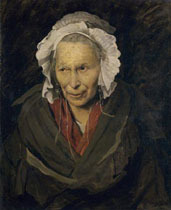
It is inevitable that these conditions, in Chenique’s estimation, would culminate in Géricault’s famous series of portraits of the insane. Turning a corner in La Folie d’un Monde, the visitor confronts, as the culmination of the exhibition, a dramatic wall featuring Le Monomane du vol (1819–20; Gand, musée des Beaux-Arts) and La Monomane du jeu (1819–20; musée du Louvre) flanking Lyon’s own La Monamane de l’envie (1819–20). Press materials lamented that only three of the five pictures from Géricault’s series of mad portraits were available for the exhibition. But, in fact, the selection highlights the curator’s argument. Thievery, gambling, and envy call attention to the desperate struggle for self-protection brought about by the social upheavals of the period. As has been argued previously (particularly by Régis Michel in the 1991 bicentenary catalogue), Géricault has often been wrongly figured as a cursed or mad artist (“un artiste maudit”) (Géricault, Paris: Editions de la Réunion des musées nationaux, 1991, xi). This legend devolved in part from the mistaken belief that Géricault painted the portraits of the insane during his own incarceration at Salpêtrière hospital. Chenique’s choice of the phrase “la folie d’un monde” as the exhibition’s subtitle is a salvo against those who have labeled Géricault a mad artist. It was not Géricault who was mad, but rather the world around him.
This revelatory Géricault exhibition was organized without the loan of major machines from the Louvre such as the Radeau de la Méduse. The Lyon show invokes the missing masterpieces in an innovative way, thereby suggesting a new path for exhibitions of early nineteenth-century French art, a field centered around a canon of large, difficult to move canvases. Sections of the missing paintings were reproduced, in sepia tones, on scrims or tissus. The suggestive beauty and melancholy of these tissus, as well as the dramatic dark wall colors, expressed the exhibition’s focus on loss and dislocation with distinctive visual clarity.
Within this strategy, Chenique most skillfully drew out the complexities of Géricault’s work through his sensitive selection of individual paintings, drawings, prints, and sculptures. The section on the absent Radeau gathered together a moving collection of works related to the finished canvas, including an écorché (1818–19; private collection) that signals the artist’s commitment to representing three-dimensional reality in a manner that differs from the shaded drawings produced by his predecessors. It is perhaps telling of Chenique’s emphasis on Géricault as an outsider that he did not include the Montauban study for the figure from the apex of the Radeau, which demonstrates, as Thomas Crow has noted, the artist’s traditional skills of modeling (Emulation: Making Artists for Revolutionary France, New Haven: Yale University Press, 1995, 290–91). Instead, another stellar object, the Louvre’s chalk, ink, and gouache study depicts nude figures in combative poses suggestive of an ancient freeze. The drawing resolves itself around a central, kneeling figure who desperately chews on the arm of a dead companion. The representation of the body at the edge of sanity is the true subject of the Radeau, and also of the exhibition Géricault: La Folie d’un Monde.
Chenique’s essay in the eponymous exhibition catalogue meticulously traces the twists and turns of Géricault’s relationship to the political left. However, the lack of catalogue entries for individual works of art is disappointing given that the exhibition unearthed so many new works. Perhaps Chenique was of the opinion that much of this material had already been covered by Sylvain Laveissière’s entries for the Grand Palais exhibition, or by Germain Bazin’s catalogue raisonné. Moreover, the exhibition and catalogue for La Folie d’un Monde were conceived and executed in less than a year. However, Chenique’s opinions on dating, and his ability to situate individual works and to draw out their nuances, would, in the form of catalogue entries, have been invaluable to future scholars.
Wide-ranging discussions of the conditions pertinent to the production of art are often absent from monographic exhibitions, and Chenique, who selected and displayed Géricault’s paintings, drawings, and lithographs in La Folie d’un Monde with skill, inventiveness, and a deep understanding of the subject, is to be applauded for bringing ideas usually circulated only among scholars to a forum meant for the general public.