
- Chronology
- Before 1500 BCE
- 1500 BCE to 500 BCE
- 500 BCE to 500 CE
- Sixth to Tenth Century
- Eleventh to Fourteenth Century
- Fifteenth Century
- Sixteenth Century
- Seventeenth Century
- Eighteenth Century
- Nineteenth Century
- Twentieth Century
- Twenty-first Century
- Geographic Area
- Africa
- Caribbean
- Central America
- Central and North Asia
- East Asia
- North America
- Northern Europe
- Oceania/Australia
- South America
- South Asia/South East Asia
- Southern Europe and Mediterranean
- West Asia
- Subject, Genre, Media, Artistic Practice
- Aesthetics
- African American/African Diaspora
- Ancient Egyptian/Near Eastern Art
- Ancient Greek/Roman Art
- Architectural History/Urbanism/Historic Preservation
- Art Education/Pedagogy/Art Therapy
- Art of the Ancient Americas
- Artistic Practice/Creativity
- Asian American/Asian Diaspora
- Ceramics/Metals/Fiber Arts/Glass
- Colonial and Modern Latin America
- Comparative
- Conceptual Art
- Decorative Arts
- Design History
- Digital Media/New Media/Web-Based Media
- Digital Scholarship/History
- Drawings/Prints/Work on Paper/Artistc Practice
- Fiber Arts and Textiles
- Film/Video/Animation
- Folk Art/Vernacular Art
- Genders/Sexualities/Feminisms
- Graphic/Industrial/Object Design
- Indigenous Peoples
- Installation/Environmental Art
- Islamic Art
- Latinx
- Material Culture
- Multimedia/Intermedia
- Museum Practice/Museum Studies/Curatorial Studies/Arts Administration
- Native American/First Nations
- Painting
- Patronage, Art Collecting
- Performance Art/Performance Studies/Public Practice
- Photography
- Politics/Economics
- Queer/Gay Art
- Race/Ethnicity
- Religion/Cosmology/Spirituality
- Sculpture
- Sound Art
- Survey
- Theory/Historiography/Methodology
- Visual Studies
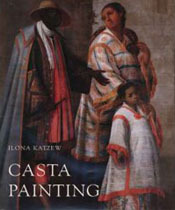
From the moment of its supposed “discovery,” Europeans struggled to understand the Indies as place, a space embedded in networks of social and historical relations and reproduced through imaginative geography. Ilona Katzew’s book, Casta Painting: Images of Race in Eighteenth-Century Mexico, derives from and examines visual examples of this tradition of imaginative geography. As with all geographies, this book is formed as a journey with an itinerary that guides the viewer/reader through both visual and textual material in an effort to examine the historical and social topography reproduced through cuadros de casta or casta paintings, a secular genre of painting that depicts Spaniards, Indians, Africans, and their mixed-blooded offspring who inhabited eighteenth-century New Spain. This densely illustrated study (there are 270 images, many half or full-page, within the 204-page text) is an exploration of an imaginative geography that fashioned eighteenth-century New Spain as place.
In a brief introduction, Katzew outlines the background, premises, and major questions of her study, proposing that casta paintings produced in the earlier part of the eighteenth century stress the prosperity of New Spain and colonial self-pride, while later works place focus on social stratification and New Spain’s commercial resources. Chapter 1, “Painters and Painting: A Visual Tradition and Historiography,” begins with the emphatic statement: “Casta paintings construct racial identity through visual representation; it is one of the most compelling pictorial genres from the colonial period in Mexico in particular and the eighteenth century in general” (5). Katzew explains this statement by reviewing scholarly literature that has added to the historiography and/or presented new insights into the production and consumption of these paintings. She also articulates her theoretical premise, which specifies a cultural contextual interpretation of the images, focusing on the associations contemporary viewers brought to the images through mnemonic functioning (9). The chapter concludes with an overview of the general history of painting in eighteenth-century Mexico and, within this, the evolution and demise of casta paintings. The fine display of casta images that fill the chapter illuminates this evolution.
In chapter 2, “‘A Marvelous Variety of Colors?’: Racial Ideology and the Sistema de Castas,” the author reviews and elaborates on the complex process of race mixing in New Spain and the construction of social race. The Spanish notion of limpieza de sangre (purity of blood), in which any presence of Jewish or Muslim blood was associated with blood impurity, thus lowering social status and rights, was transferred to New Spain, with the blood of Indians and Africans substituted for that of Jewish or Muslim blood. By the mid-seventeenth century, miscegenation among Spanish, Indian, and African individuals was demographically evident to Spanish authorities, and a cognitive and legal system of hierarchically arranged mechanisms of social control was instituted by Spaniards and creoles to preserve their social position and power. The resulting sistema de castas catalogued sixteen to twenty-two different variants of miscegenation, citing, for example, that the mixing of Spanish and Indian blood resulted in a mestizo offspring, Spanish and African mixing produced a mulatto, and Indian and African mixing generated a lobo, etc. Here, Katzew steps onto the difficult and often slippery ground of racial discourse in attempting to distinguish genetics-based race, a nineteenth-century construct, with which most readers come to this text, from social race of New Spain derived from limpieza de sangre constructs. (Footnote 2 (210) provides the reader with a lucid explanation of the changing meaning of race over time.) To illustrate the problem of eighteenth-century racial discourse, she reviews “Ordenanzas de Barratillo,” an unpublished manuscript and the earliest known satire produced in New Spain, and demonstrates the literary dimension of social race and race mixing and the entrenchment of racial concepts.
After arguing for the primacy of racial construction for casta painting in the first two chapters, Katzew seems to hesitate a bit midway through the book, initiating the next chapter with the statement: “The socioracial stratification of Mexico constitutes the subtext of casta painting, but other subjects are as important in considering its emergence and development” (64). Thus, chapter 3, “The Rise of Casta Painting: Exoticism and Creole Pride, 1711–1760,” outlines the likely iconographic sources for the creation of casta paintings. Katzew traces the European fascination with exotica from medieval interest in customs and mores, comparing casta-painting topics and format to prints from Cesare Vecellio’s Habiti antiche et moderni de tutto el mondo . . . (1598). She further investigates how casta paintings were formed around the European “culture of curiosity,” that is, a fascination with non-European culture, touching on recent research on the notion of wonder and curiosity in late-medieval and early Renaissance thinking. At the same time, in the early part of the eighteenth-century creole pride in New Spain manifested itself in textual and visual materials. She proposes that European fascination with the Americas combined with Spain’s obsession with racial purity contributed to the emergence of these paintings.
In this chapter Katzew also analyzes the works of two artists of the second half of the century, Juan Morlete Ruiz and Miguel Cabrera, and their circle. She argues that these artists reformatted casta paintings and introduced iconographic elements that established new standards for these paintings. The new elements included depicting more detail in clothing to indicate socio-economic class, clearer identification of urban/suburban settings, and psycho-physical contact between figures that cumulatively resulted in “unequivocal ordering of colonial society” (109).
The fourth chapter, “Changing Perspectives: Casta Painting in the Era of the Bourbon Reforms, 1760–1790,” examines the implications of social, political, and economic reforms instituted by Bourbon kings after disastrous wars resulted in the loss of European holdings. Spain sought to regain its power by assaying the promising human and natural resources of the Spanish Americas for economic renewal. Katzew connects post-mid-century casta paintings with their expanded iconography to an invigorated interest in the natural history of New Spain for commercial expansion. Adding another facet to her discussion of the construction of social race, Katzew argues that the classification systems associated with this natural history research and casta paintings suggests, “a way of representing the unrepresentable; an attempt to quantify, and thus control, the fallibility of colonial social rigor” (151).
In chapter 5, “The Theater of Marvels: Casta Paintings in the Textual Microcosmos,” Katzew moves, through analysis of contemporary history and natural history writings, to a discussion of how eighteenth-century Spanish viewers may have comprehended these paintings. She undertakes an extended case study of a fascinating 1763 text by Joaquín Antonio Basarás, “Origen costumbres y estado presente de mexicanos y philipinos,” an unpublished manuscript held in the Society of the Americas collection (New York City). Basarás, a Spaniard and prominent entrepreneur, seems to have commissioned this report about the history and customs of the Philippines and, especially, New Spain. Reflecting a Bourbon economic perspective, the text emphasizes the potentially abundant resources of New Spain and is illustrated with diverse images showing flora, fauna, scenes from daily life, and, of course, castas. Basarás’ work provides evidence that, by the last third of the eighteenth century, firmly established iconographic elements were replicated across texts.
In her closing section, “Concluding Remarks: A Genre with Many Meanings,” Katzew synthesizes the material of earlier chapters and concludes overall that casta paintings “encode a multiplicity of simultaneous meanings” that were decoded by the contemporary viewer (201). Exploring this multiplicity, she interprets casta paintings, at their most basic level, as shaped by Spaniards’ and creoles’ long-standing obsession with racial genealogy as a form of resistance by the nobility against encroachment on its privilege and source of wealth. Early casta paintings embody elite forms of control, showing the healthy and wealthy body politic. Post-1760 images reference late eighteenth-century interest in classification systems, influenced by the taxonomic work of Carolus Linnaeus. De-accentuating casta painting’s direct construction of race, she summarizes: “Casta painting represents the ordering of colonial society and in so doing partakes of the very construction of racial identity” (202). Finally, she reminds the reader that rather than evaluating colonial art of New Spain as derivative of European models, casta paintings testify to the generative abilities of New Spain’s cultures and its artists.
Casta paintings are challenging to study and interpret because there is relatively little primary documentation about their production, patronage, or consumption. Katzew takes on this challenge, and her accomplishments are important and significant in the resulting study. These achievements, however, are not in the form of new or definitive conclusions about the meaning of casta paintings. Other scholars who have studied these images have come to a similar conclusion: casta paintings are highly fluid and contextual in their meaning and consumption. Katzew, however, brings the full power of her art-historical training and curatorial background to craft this outstanding project that combines an exhibition-like display of dazzling casta images as well as other visual materials, and a well-researched scholarly essay. She brings to light unpublished primary texts that effectively elucidate the socio-historical context of the production and consumption of this secular genre of painting. Katzew brings the reader/viewer to an understanding of the “multiplicity of simultaneous meanings” of casta paintings.
Katzew further assists her reader in recognizing the contingent and constructed characteristics of colonialism in New Spain. As Raymond Hernández-Duran elucidates in his dissertation, Reframing Viceregal Painting in Nineteenth-Century Mexico: Politics, the Academy of San Carlos, and Colonial Art History (University of Chicago, 2005), Mexican historians invented the Colonial Period in the early nineteenth century in an attempt to contextualize Spanish political and economic domination within a nationalist historical discourse. Scholars continue to elaborate on this invention. In Katzew’s work, we encounter both the imaginative geography constructed by Spanish and New Spanish elites as they struggled to clarify and come to terms with a periphery/metropolis relationship, as well as our own imagined notions of colonialism.
Magali Carrera
Department of Art History, University of Massachusetts Dartmouth