
- Chronology
- Before 1500 BCE
- 1500 BCE to 500 BCE
- 500 BCE to 500 CE
- Sixth to Tenth Century
- Eleventh to Fourteenth Century
- Fifteenth Century
- Sixteenth Century
- Seventeenth Century
- Eighteenth Century
- Nineteenth Century
- Twentieth Century
- Twenty-first Century
- Geographic Area
- Africa
- Caribbean
- Central America
- Central and North Asia
- East Asia
- North America
- Northern Europe
- Oceania/Australia
- South America
- South Asia/South East Asia
- Southern Europe and Mediterranean
- West Asia
- Subject, Genre, Media, Artistic Practice
- Aesthetics
- African American/African Diaspora
- Ancient Egyptian/Near Eastern Art
- Ancient Greek/Roman Art
- Architectural History/Urbanism/Historic Preservation
- Art Education/Pedagogy/Art Therapy
- Art of the Ancient Americas
- Artistic Practice/Creativity
- Asian American/Asian Diaspora
- Ceramics/Metals/Fiber Arts/Glass
- Colonial and Modern Latin America
- Comparative
- Conceptual Art
- Decorative Arts
- Design History
- Digital Media/New Media/Web-Based Media
- Digital Scholarship/History
- Drawings/Prints/Work on Paper/Artistc Practice
- Fiber Arts and Textiles
- Film/Video/Animation
- Folk Art/Vernacular Art
- Genders/Sexualities/Feminisms
- Graphic/Industrial/Object Design
- Indigenous Peoples
- Installation/Environmental Art
- Islamic Art
- Latinx
- Material Culture
- Multimedia/Intermedia
- Museum Practice/Museum Studies/Curatorial Studies/Arts Administration
- Native American/First Nations
- Painting
- Patronage, Art Collecting
- Performance Art/Performance Studies/Public Practice
- Photography
- Politics/Economics
- Queer/Gay Art
- Race/Ethnicity
- Religion/Cosmology/Spirituality
- Sculpture
- Sound Art
- Survey
- Theory/Historiography/Methodology
- Visual Studies
My work for the last few years has gone beyond defining modernity in Asian art to looking at the circuits for the recognition and distribution of contemporary art in Asia. In particular these involve two simultaneous phenomena.1 The first is the arrival of contemporary Asian artists on the international stage, chiefly at major cross-national exhibitions, including the Venice and São Paolo Biennales. This occurrence may be conveniently dated to Japanese participation at Venice in the 1950s,2 followed by the inclusion of three contemporary Chinese artists in the Magiciens de la terre exhibition in Paris in 1989. The trend continued with the arrival of Chinese contemporary art at the Venice Biennale in 1993. This arrival and circulation intensified until 2005 when China opened its first, officially supported exhibition at Venice; in the future, it will have its own pavilion.3 By 2005, Hong Kong, Taiwan, Indonesia, Singapore, Thailand, and indirectly India were regular participants at Venice in addition to Japan and Korea from the 1950s and 1980s respectively.
The second phenomenon is the rise of the biennale as an international exhibition form in Asia with the participation of contemporary Asian artists. This actually started with the Biennale of Sydney in 1973 when artists from Bangladesh, Indonesia, Japan, Korea, Malaysia, Philippines, and Thailand were exhibited. But the major recent and internationally more noticed impetus came with establishment of biennales and triennales at Gwangju in Korea in 1995, Shanghai in 1996, and Guangzhou in China in 2002. The movement was widespread and simultaneous with the 1999 conversion into the Fukuoka Asian Art Triennale of the Fukuoka Asian Art Show (begun in 1989), and the establishment of the Asian-Pacific Triennial of Contemporary Art at Brisbane in 1993.
Contemporary Asian art has various functions for the host country in these different sites and types of exhibitions:
1. Displaying its artists at an international level, and giving them and their works the cultural consecration to enter overseas commercial art markets
2. Providing a base for international networking by its artists, curators, and cultural bureaucrats
3. Securing a reputation for national prowess in a contemporary cultural field, which may reinforce other perceptions of national prowess
4. Demonstrating prestige for the continued fecundity of “old” cultures
There is a separate and sometimes conflicting set of functions for the international art world that may be categorized as:
1. Securing additional national, artistic, and curatorial recruits for its own international circuits of recognition and distribution
2. Securing further confirmation of its own artistic criteria and previous selections and consecrations of artworks
3. Providing variation in the production of existing work types, thereby reinforcing those practices
4. Or, providing radical departures and innovations that confirm the status of this or that contemporary art as “leading edge”
These exhibitions have thrown up many issues concerning the ongoing definition of modernity in Asian art and its contemporary international circulation, topics I have examined elsewhere.4 Rather than theoretically discuss this plethora of phenomena relevant both to contemporary Asian art and to international art, I will look at the exhibitions I saw in 2005 and raise the broader issues as I encountered them, site-by-site.
Venice Biennale 2005
It has often been remarked by casual visitors to the Venice Biennale that Venice is not really an appropriate site for a contemporary art exhibition, let alone for a biennale, because it is sited on one island in a group of small islands. Moreover, the city was mostly built before the nineteenth century, has no economic base other than tourism, and is not a modern cosmopolitan city, but actually a minor regional center with a small population. It even has its own ancient buildings garlanded with propped-up sculptures and acting as artistic pilgrimage sites.5 During the July tourist season most of the palazzi on the grand canal have no lights on at night. Venice thus comes to the visitor as isolated from the world, and the event of the Biennale and the small performances that surround it have no local social base with which to interact, unlike Fukuoka, Istanbul, or Liverpool, for example. Indeed, apart from the circuit of international art exhibitions and the fact that the opening of the Venice Biennale is held at almost the same time as the Basel Art Fair, only some six or so hours away by train, the Biennale would have little meaning in itself. Its significance appears more clearly to depend on a cycle of competitive positions between states where works, artists, and curators may be inserted into an international circuit of display and influence. This year Venice, next year São Paolo, every five years Documenta, with all the host of smaller events located in between.
It is fascinating how many traces of other biennales are to be found at the Venice Biennale itself. In 2005, for example, I deliberately avoided going to the opening days because of the atmosphere of curatorial hype at the vernissage. I later came to regret this because my view of biennales changed to seeing them as mostly, if not primarily, oriented to other curators and the audience that already had agreed with the curatorial positions the biennales advanced.
Despite this curatorial display, the personal experiences engaged by going to biennales are still important, and I think remain primary material for understanding their operation. In 2005, I pulled up short as I stepped over the threshold onto the street side of the Brazilian pavilion. I had almost put my foot on a brochure for the forthcoming 2006 Biennale of Sydney, which was lying on the Brazilian pavilion doorstep. Wherever I took my eyes off art for a second, there was advertising for another similar art event. The Korean pavilion contained promotional material for the 2006 Gwangju Biennale. The Japanese pavilion actually featured a poster outside its doorway advertising the 2005 Yokohama Triennale, which would open a bare three months later. I was in danger of losing myself in a semiotic loop where the inter-referentiality of biennales reinforced by advertising was as important as any particular group of artworks they materially assembled.
The “again-ness” of the biennale circuit produces an imaginary or virtual quality for seeing any works at a given physical site. After three visits in six years there is now, for me, an interesting if slightly phantasmic sense in which I am beginning to precisely coordinate the moment I saw a work with its site within the Giardini or the Arsenale, and feel I know these sites better than some of the streets outside through which I may have walked several times. I have had the same sensation of “again-ness” elsewhere, and it may be a feeling that allows one to identify—independently of other qualities—that one is traveling on an art “circuit.” For example, I have had this feeling about formally different and supposedly conceptually discriminated works by Miyajima Tatsuo I have seen in Brisbane, Gwangju, and Sydney.
“Again-ness” is further sanctioned by the many works in the thematic or curated exhibitions I had seen or heard of before the biennale. In a world of extensive printed art media, let alone web communication, this feeling can no longer be restricted to specialists with peculiar access to information or travel opportunities. Artists like the Korean Choi Jeong Hwa have claimed to me that every biennale is different and every work different, but he also indicated he had worked over time with both Nanjô Fumio and Apinan Poshyananda at Lyon, Liverpool, and other international exhibitions.6 No, he did not feel he was functioning as the local producer for a multinational corporation, and anyway he met different people and went to different countries, opportunities he would not otherwise have had but for biennale invitations. In another case, Jun Nguyen-Hatsushiba Jun has done his underwater video pieces in various international sites,7 but when one sees them together, as I did in 2004 at the Mori Art Museum in Tokyo, I was left with the overwhelming sense that these works were essentially a thematizing of the same technique and conceptual problem even if they all had ostensibly different subjects. Nguyen-Hatsushiba’s work seems to have become most “recognized”—“consecrated” is Pierre Bourdieu’s term—at the Yokohama Triennale in 2001 and by his retrospective at the Mori Art Museum in May–June 2004. Various unattributable opinions circulate informally in the international art world in which it is supposed that Hatsushiba-Nguyen had been over-encouraged in his current direction by particular curators or curatorial idées fixes. Whatever the artist’s intentions and the complexities of the works’ execution, only the relation to a repeated or conventionalized notion of significance could allow for their repetitiousness, and this was presumably a notion that had been mediated by a curator or group of curators.
Curators often mention the exchange of opinions as part of informal and usually non-public professional practice. There is a genuine view that this is more than simply an exchange of opinions, and at the very least amounts to a kind of field coordination by those in the know. A curator, newly admitted to this flow of opinions, told me of being somewhat secretively taken to a meeting on a private yacht off the coast in the Bay of Finland where the curator found himself, to his surprise, in the company of peer curators of contemporary art from all over Europe who proceeded over dinner and alcohol to compare notes on those “international” artists currently active in or recognized for certain kinds of practice. Almost all active curators I have met have also been unwilling, on the record with this art historian, to discuss the role of other curators’ interests and selections in their own choices of artists or works, a fact that points to the extreme sensitivity of such professional and commercial information.
To return from the tenor of curatorial operations to the structure of biennales, the Venice Biennale presents itself to the viewer as a complex of essentially three types of exhibitions:
1. The national pavilions and one curated thematic pavilion in the Giardini plus often another and separately curated retrospective exhibition in the Museo Correr in Piazza San Marco
2. One or several thematic exhibitions in the Arsenale, usually organized by sub-curators whose funding appears to be largely self-secured
3. Other small exhibitions dotted around the city, sometimes of national states, sometimes of sub-state regional arts organizations, sometimes of private collectors, sometimes of a commercial gallery
Japan and Korea have permanent pavilions in the Giardini. It is believed they will be joined there by China in 2007, whose 2003 participation was cancelled because of the SARS epidemic, and which had its own dedicated area at the end of the Arsenale in 2005.
The national exhibitions at Venice all more or less fall across the functions outlined in the preamble above. In 2005, the China national area was clearly interested in demonstrating the profound abilities of contemporary Chinese artists to reflect modern cultural and technological change. In the case of Sun Yuan and Peng Yu, this appeared to be demonstrated by the irony of having a manifestly non-functioning, pseudo-space vehicle transported, counter cargo-cult direction, to a European place. The projected work of Xu Zhen in the old oil room of the adjacent end of the Cordillieri was unfortunately almost invisible when shown on the dark oil tanks. As it turned out, my digital on-site photograph was better than the appearance of the actually projected images. It would appear the artist had not been able to, or had not cared to, investigate the projection conditions, and such difficulties might have been obviated by a permanent pavilion whose display environment was regularized and known. (This example actually runs counter-intuitively to the conventional proposition that national pavilions are a bad thing in distorting art practice and representation for nationalist purposes.) Actually the names of all these artists were well-enough known before Venice, and Sun Yuan and Peng Yu had been seen at Gwangju the previous year, so the networking and display of national prowess would appear to have been the function the exhibition fulfilled, not that of making already known artists even better known.
If exhibiting outside the Giardini or Arsenale, the choice of site can be very significant for getting international art curators to visit. Taiwan has always had a very prominent site, in the former prison—actually, in its former interrogation chamber, as some of the wall inscriptions testify. But the experience of Thailand and Hong Kong may be usefully contrasted. In 2003, Thailand had a temporary so-called “Thai” house at the end of a park, and produced a kind of street event plus various performance pieces in addition to several works hung inside the “house.” The overall impression was an attempt to create a kind of “oriental exotic” as a way of denying the “oriental exotic” category in which the curator thought the Thai contemporary artists might have been put. The Thai pavilion in 2005 was far more sober, with only two relatively well-known artists who work with religious or tragic scenes, and was sited in the cloisters of a disused monastic area. The greater aesthetic impact came at the price of distance from the center of the superficial curatorial action. But I suspect the function of having national prowess in contemporary art recognized was secured by the exhibition of the mature works in 2005, not the cleverly intended counter-discursive razzamattazz in 2003.
In the case of Hong Kong, in 2003 there was a rather interesting if brutally simplistic conceptual exhibition by the Para/Site Collective in a house directly across from the entrance to the Arsenale. The installation was composed of cushions for repose inside sections of large concrete water or sewer pipes. While the exhibition may have publicized Hong Kong as a site of contemporary practice, identification with the group Para/Site may not have functioned so well for the individual artists who composed it. In 2005, Hong Kong rented a palazzo on the Grand Canal and installed a rather meretricious upside-down model of Venice by Chan Yuk-keung along with a work composed by the pseudonymous AnotherMountainMan from blue-and-white, plastic-wrapped tea utensils as a vestigial kind of Hong Kong café. This was easy to access in a contemporary idiom, but unfortunately there was not enough aesthetic depth in the work to provide for the national and artist-enhancing lift found, for example, in 2003 by Tse Su-Mei at the Luxembourg pavilion.
In sum, the exhibition of contemporary Asian art at Venice has begun to change the flavor of art exhibited, although most works fit within emerging Euramerican categories. What it has done is to fulfill networking and market access functions for artists and national demonstrations of contemporary cultural prowess functions for states.
Fukuoka Asian Art Triennale 2005
The Fukuoka Asian Art Triennale, the third iteration of which I visited for the first time in 2005, presented quite a different exhibition spectacle, consisting of fifty artists from eighteen countries. Here was a permanently locally sited exhibition within a national state claiming a regional function by its selection of artists and themes. It is Fukuoka’s lack of pretension that is its saving grace. Since the exhibition is created by the fully resourced, dedicated Fukuoka Asian Art Museum, which has made extensive purchases from both the triennales and its preceding Asian Art Show, as well as other purchases between exhibitions. Thus, the ability to make curatorial judgments autonomous of existing criteria within the international art world is enhanced. Although artists are still listed by national categories, because there is no national selection, they are chosen—through an overlapping and complex series of local referees and selection committees—not merely on the basis of work.8 National prowess results from an independent and distanced external selection with a local voice included in parts of that process, rather than one tied to a domestic choice being presented to international curators.
Despite the exhibition by national affiliation, Fukuoka (and also Brisbane’s Asia-Pacific Triennale of Contemporary Art) would seem—based on anecdotal evidence from several artists—to function more for the status enhancement of artists rather than national states. Both Lee Bul and Wong Hoy Cheong would appear to have moved to much greater international prominence after the exposure at the 1st and 2nd Asia Pacific Triennales in 1993 and 1996.
Several artists from Southeast Asia have spoken of being impressed by the thorough research done on a recurrent basis by Fukuoka curators, and have found beneficial the opportunities for contacting other artists active in the same fields. One artist commented that the Fukuoka team came every year and knew about all her latest exhibitions, but curators from the Asia-Pacific Triennale came only infrequently and were not so much interested in her work as in whether her work could fit in a pre-established curatorial category they had assigned for it.
However, with the advent of the Yokohama Triennale in 2002, it is likely the consecrating or prescriptive function for biennales in Japan has shifted to Yokohama because of its widening to the Euramerican art world. One may hypothesize that only one such “center” per nation state is likely to be accepted as prescriptive in an international art system still largely governed by nation states and national art markets, and certainly by a restricted and largely Euramerican international coterie of curators who dominate the consecration of artworks. But this statement must be made with some reservations about a market sourcing for contemporary artworks that saw the post-World War II integration of the European and North American art markets. The tendency showed signs of being extended to Asia during the later 1990s with Asian contemporary art sales by major auction houses such as Christies. Substantial segments of this market, certainly in higher-priced items and including works by some contemporary Asian artists, may now be on the way to becoming global.9
Apart from providing a securely based, relatively large-scale and well-resourced museum with a research-competent curatorial staff,10 Fukuoka has also intended to steadily increase the participation of local residents with artistic activities via artist workshops and collaborative projects.11 The Fukuoka Asian Art Museum has made serious efforts to broaden or go beyond conventional definitions of art accepted from Euramerica by Japan’s national art museums and more than one thousand other public art museums.12 It has, very rightly I think, tried to understand that, beyond the purview of the local elite and its institutionalized “modern” concepts of art, in many Asian cultures certain kinds of visual or decorative expression found in public transport or sign decoration are a kind of street “art” which at the very least counters that institutional definition. Asian streets are full of paintings on transportation—from trucks and buses to rickshaws, that is, where they are still allowed to survive. Many folk religious sites overflow into the streets with images of gods or colorful sites for offerings, and all of these infuse with everyday commercial advertising and popular culture.13 However, such a placement or re-definition requires collaboration from the institutional side in re-defining art—from other artists, curators, and exhibiting institutions in Japan—but this does not seem to have happened. It would appear to have been nearly impossible to get artists and their notion of artworks in Japan to move very far toward accommodating this changed placement of art. This despite moves to open up Japanese art exhibitions to popular culture in the form of objects from postwar culture or cartoons.14 In addition, the 2005 Fukuoka Asian Art Triennale also saw an attempt to expand the geographical range westward to include Pakistan.15
But Fukuoka is not Tokyo, and despite the city government’s plans to raise the status of the city by advertising it in Japan and overseas as an Asian gateway, neither is it an Asian city in terms of population. For instance, 1.1% of its population is of other-than-Japanese Asian origin, but the other-than-Australian Asian population of Sydney is at least ten times or so higher.16 Australia, one should also recall, is not categorized at Fukuoka—or indeed by the Japan Foundation—as an “Asian” country, and is not invited to send artists to exhibit there, even though “Asia” is far more a part of Sydney life as a result of that city’s population dynamics (before we discuss anything else) than Fukuoka.
The Asian Art Triennale seems only to have been able to impress itself on the Japanese art scene as one kind of regional activity. This has been the case despite the Fukuoka Asian Art Museum and its predecessor base at the Fukuoka Art Museum holding many original exhibitions, including some of major art-historical significance,17 and despite the laudable and persistently committed efforts of the Japan Foundation with exhibitions at the now defunct Asia Centre. The Asian Art Triennale appears to have functioned neither to redefine the notion of art in circulation in contemporary art circles in Japan, nor to have substantively placed “Asian” contemporary art on the central agendas of the rest of the Japanese museums and contemporary art galleries circuit.
Country-Specific Collections in Europe
Asian artist participation at biennales has developed in the presence of private collections, sometimes through the two or three Asian commercial galleries that show at the Basel Art Fair, but usually through direct collecting overseas, and importantly in China. There are up to four major collections of contemporary Chinese art in Europe, some of which have been exhibited in recent years.18 The problematic identification of contemporary “Asia” with “China,” no doubt shortly to be joined by “India,” is obviously driven by strategic considerations of present and future political and economic importance, “art” merely serving as the sign of a kind of social dynamic or contemporaneity. The exception is the permanent interest in contemporary art in India found in the United Kingdom, reflecting perhaps the cultural residue of imperial links, the size of the resident population of South Asian origin, and the minority but important role of artists and critics of South Asian origin in British art discourses. The latter have figured in extensive debates about minority and black arts, which have come to occupy a central place in intellectual agendas outside their own communities, and are symbolized by the long-standing presence of journals such as Third Text and organizations such as IniVA. Nothing like this situation exists so far as I am aware in France or Germany, nor in Japan, even with the concern of a small number of intellectuals for the largely assimilated Korean minority. It seems clear that there is almost no working comprehension in Europe and North America of Southeast Asia as a source for contemporary art save perhaps for the two or three artists who have become known internationally as coming from Thailand and Indonesia, such as Rirkrit Tiravanija or Heri Dono. But more seriously, there is almost zero understanding of the dialectical and critical relation of a “modern Asian art” to “contemporary art,” meaning “contemporary art made between Rome, Paris, Frankfurt, London, New York, and Los Angeles.”
It is in this lack of understanding that the importance of major collections of contemporary Asian art becomes clear. They change the range of works and artists seen as worthy of an impact on contemporary art discourses and definitions of art; they modify the locations that have to be considered in any process of constituting a canon; they force a revision of the cultural histories capable of constituting a modernity; and perhaps, they increase a small minority of elite focus on a modernity that may redefine what modernity is for all art cultures.19 Since such collections are seen by other European collectors, and by European curators preparing major international biennales, they change both the sample of countries to be visited and perceptions of the depth of serious attention they require. This “educative” function may already operate for some curators. The Sigg collection in Bern has been visited by the curators of the forthcoming 2007 Documenta, and this visit would appear, from my conversation with Ulli Sigg in Bern in August 2005, to have greatly reinforced their perception of the importance of Chinese contemporary art and the amount of time they would have to spend in China in order to select from it.20
Moreover, if the collector is a significant figure in the business or political elites of a European country, she or he brings a kind of leadership charisma to the works in a collection. The work then becomes a set not merely of well-selected exemplars of contemporary art from a particular country, it becomes a category of objects of significance that are worthy of understanding and discussion as representative of cultural constructions or states of social consciousness. These objects may also constitute signs of powerful, cultural access to countries that are now becoming economically dominant. These perceptions of “Asian” cultural constructions underlie the very forces that bring such elites into contact with contemporary Asian countries. “Contemporary art from China” also begins to stand as exemplar of “contemporary Asian art” in the minds of those who may not otherwise be inclined to view it as significant or worthy of contact, let alone a personal symbolic act of cultural encounter.
The Sigg collection in Bern is particularly noteworthy because it was assembled by a Swiss businessman who had been interested in contemporary art since his student days, even though—so far as I am aware—he did not formally study art history. Thus a profound knowledge of what constitutes modern art as an expression of modern life in Europe informed Sigg when he went to China in 1979 as a businessman to secure the first joint-company agreement for the Schindler lift company. He did not collect contemporary art at that time because it might have been detrimental to his business activity; but when he returned to China in 1994 as Swiss ambassador, political intervention into contacts between foreigners and Chinese had considerably lessened, and he was able to freely meet artists and collect their work, in part because of the status he had built up in official circles from his earlier stay. It may also be that he had particular diplomatic skills that did not make a great play of his collecting or of conveying to the “West” a particular interpretation of contemporary Chinese art. Moreover, he did not advertise the fact that he was the patron of the Contemporary Chinese Art Prize won by the currently internationally renowned Zhou Tiehai.21 To assist in the adjudication of this prize, Sigg brought in several famous contemporary art curators from Europe, such as Harald Szeemann.22 Undoubtedly the fact that Sigg was European and Swiss, and not American, may have allowed him some discretionary freedom that other collectors would not have enjoyed.
Sigg’s collection is unlike others in its historical depth; he carefully collected works of the Cultural Revolution that are precursors to the modern art that was to arise in the 1980s. Unlike all other contemporary Asian art exhibited at biennales, that of contemporary China has some kind of historical background since many European curators, including Szeemann, have been concerned with China since the Cultural Revolution. This implicitly informs the way contemporary Chinese art has been seen since it appeared at Venice in 1993, but Sigg is rare in trying to make certain his collection has this depth. The wave of experimentation in recent Chinese art arose partly as a reaction against Cultural Revolution art, and partly in unconscious but rebellious tribute to its iconographic power, since many of the contemporary artists had at some time been dominated visually by it. In certain cases, as young student artists in work brigades, they actually produced it, as in the example of Wang Guangyi. Sigg has also collected what he considers to be a representative selection of Chinese artists from the 1990s, even if he was able to identify early on that some would not necessarily develop very far. This broad-mindedness and long-term historical understanding, let alone his particular knowledge of the context of Chinese contemporary art, was uncommon in Chinese art curation in the 1990s. It remains rare among many international curators of contemporary art, as testified to by the sometimes dreary repetitiveness of their selections of Chinese artists. In other words, enlightened collecting can be the way around the highly restricted choices made by contemporary international curators who frequently do not have the time, resources, or it must be said, cultural open-mindedness, to incisively penetrate into any particular.
I hope it will not be thought I am over-praising Sigg, but it must be acknowledged that the history of contemporary art is in part structured by what artworks are actually found in collections. We know in any case that many longer term art-historical constructions are the result of museum and private collection policies in the nineteenth century, for example, in the taste for a Rembrandt, a Vermeer, or a Chardin. Contemporary art is no exception, beginning with the collections of the Museum of Modern Art in New York and their support by significant sections of the US financial elites in the 1930s. Therefore, in the structure of actual existing patronage, whatever one might think about the conditions of economic advantage underlying it, the larger the range and historical representativeness of modern Asian art collections (as in the Sigg Collection), the more likely its complexity and relational importance to contemporary art elsewhere will be seen.
Yokohama Triennale 2005
The Yokohama Triennale of 2005 was the second such event, the first having been in 2001. The previous version had been curated by four different curators, but the 2005 Triennale, in contrast, was curated by a single artistic director. This was originally intended to have been the architect Isozaki Arata, who was appointed in June 2004, but he resigned in November 2004. He was replaced at very short notice in an announcement of December 10, 2004, by the sculptor Kawamata Tadashi, to be assisted by three professional curators.23 I have examined the 2001 Triennale in detail elsewhere,24 but here I should note that the 2001 Triennale was premised on the obsolescence of a scientific approach which would not provide any answers to the problem of “how to relate as individuals to the whole, or how the individual can be singled out from the whole.”25 The exhibition was grandly envisaged in the title “Mega-Wave” as “drawing in the accomplishments of all fields of human endeavour.”26 Curator Tatehata Akira was wary that supposed mutual respect for cultural difference can also be a ploy by which chauvinist essentialism is let in by the back door.27
The 2001 system of four curators was roundly criticized in a retrospective article by one of them, Nanjô Fumio,28 in which he wished to see it replaced by a single overall director who could take responsibility, together with a nonprofit company in charge of organization. This would differ from the system at Yokohama 2001, where the Japan Foundation, Yokohama City, NHK, and Asahi Shinbun were all on the actual organizing committee. Despite his comments, this system was to be replicated in 2005.
When Isozaki was announced as director in 2003, it became clear he wished to work through local, nongovernmental organizations rather than through mediating curators whom he saw as invested in the commodification of art from which he wished the triennale to escape.29 It is a measure of his inability to achieve this that he resigned in 2004, leaving the committee and chiefly Yokohama city officials to find a new curator with less than six months before the Triennale’s opening. Kawamata seems to have relied on those artists and artists’ groups known to himself, the curators, and other Japanese museum institutions;30 but there may have been a residue of Isozaki’s plans, as evidenced by the reliance on art groups as referral entities, especially for China and Southeast Asia.31
Clearly there is a note of insider weariness reverberating through the exhibition’s title Art Circus (Jumping from the Ordinary) as well as the Triennale’s siting in a temporarily unused warehouse area next to a pier. Whether or not biennales/triennales need to mobilize all the positioning possibilities of a site is a debatable issue. Certainly Yokohama is a port with an international outlook, and is full of large and high-tech harborside buildings. But one could think that artworks that were not high-tech might be seen with disfavor as a result of environmental cueing from the local architecture. Maybe this quest for the high-tech was the reason why there was a long queue on the first day of the Triennale to view one work by a former member of the Dumb Type group. I was there to see what on a subsequent day appeared to be a rather banal attempt at gothic uncanny, but which used various kinds of what I can only think was considered avant-garde, “of this moment,” techno-punk involving a computer-calibrated lightshow over a carefully organized model landscape.
The notion, too, that Yokohama has a large “Chinese” population may stimulate the view that it is open to the outside world; this, in turn, allows for the thematizing of buried cultural possibilities in video and other pieces by the Long March group or Jiang Jie’s installation Swimming Dragon in Yamashita Park, made from a semi-buried Chinese tiled roof—a work shown the previous year in Paris on, I believe, the river bank near the Cité des Arts. It also leaves room to think why works should be chosen in a happenstance way based on where they were previously sited. This previous siting is unknown to most of the Yokohama audience. But a consideration of the likely actual size of the “Chinese” population in Yokohama makes the cultural opening seem less than it is made out to be, as seen above in the case of Fukuoka, which has an “Asian” population only one tenth of Sydney’s.
When your biennale/triennale largely selects artists the curator(s) “know” or who are from groups “known to” the curator(s), taste is substituted for more local or regional art-critical or curatorial advice, and a search for innovation or profundity, or a piece (re-)installed in relationship to the local environment, is neglected. Some chain of aesthetic demand breaks down, whether conceptually or practice-lead. This became clear in the thematization of “Chinatown” works mediated by Beijing’s Long March group, whose mixed-media installation—which included a dragon in army camouflage, a video, an oil painting of New York’s “Chinatown,” and other works—was situated in a small corner of the enormous warehouses. A group project can easily become a kind of kindergarten art assignment (Let’s do a Lion Dance/Chinatown theme!) by friends of the group leader who has secured the exhibition “spot” and mobilized the funds to bring the works there. It may be serendipitous that some of the work is interesting, such as the video by the significant artist Qiu Zhijie (a member of Long March), but not so much if shown in less than ideal conditions: the passing crowds, the corridor placement, the domestic monitor without full sound and theater projection.
Selections by an artist can be beneficial, however. I found myself marveling at the “throw-away” beauty of the paper cut-outs made from takeway food bags, which were haphazardly stuck on the side of a container containing another work. Perhaps this was a selection of the artistic director? Then I sat down on a sofa nearby and found myself listening to music coming from a slightly open door, which on closer inspection I discovered could not be opened. It was another work by the same artist, Teruya Yûken. There was a label saying that the recording was of a cello piece made of a performance by Pablo Casals for President Kennedy of a Catalan melody Casals refused ever to play in Spain during the rule of Franco. Specifically, the recording was from a November 13, 1961, White House performance at which Casals played “The Song of the Bird.” “This piece asks the viewer to compare the present political posture of the United States with a former situation in which the U.S. president invited Casals, a lifelong pacifist, to the White House in the middle of the Cold War.”[32 The interpretation might be that a modern art audience can hear (the song of peace) but not get (into the palace)? Whatever the artist’s meaning, I note simply that this conceptual and operational simplicity, coupled with the awareness of the viewing conditions of the Triennale, was one of its deep aesthetic experiences for me.
The ability of an artistic director with curatorial help to get around mediated selection processes could be also what allows a biennale/triennale to handle tricky political material that might be censored from a bilateral exhibition. This was, I think, the case with the Taiwanese artist Yao Jui-chung (Yao Ruizhong), whose Yokohama Triennale installation work—The World Is for All—China beyond China, with its carefully glazed over photographs, its electronically activated gun (which unfortunately was out of order when I was there), and with what was, I presume, its knowing commentary on the relationship between images of the past and the way they might be illuminated by violence—surely would not have got past less permissive curatorial situations.
However well-intentioned or conceptually positioned, I am sure biennale/triennale directors are unable to escape the fashions of a time. This is because the inclusion of certain artists or groups will have an undeniable appeal to a segment of the local audience. This was particularly so in the selection of Nara Yoshitomo + graf, a Japanese grouping articulated around the mega-success of one artist Nara, who is not only a gallery collectable artist but is also someone whose collectables include badges and other commodity paraphernalia beloved of children, adolescents, and young adults. All these were on sale in the exhibition shop. It may be that such work is worthy of serious attention beyond the level of consumer fashion.33 As I went around the collective work Yokohama Seaside Tenement House, I thought I wanted to give the benefit of the doubt to this position. But when there are so many countries where people live in “tenement houses,” and no doubt parts of Yokohama where the hoomuresu (Japanese for “homeless”) actually do live in cardboard boxes and plastic sheet tents, I really wanted to see this point brought out in the elaborately labyrinthine passage from one shack wall to another covered with emblematic kid’s seal drawings. One might have thought this critique was the artists’ intent, until one came to the booth selling drawing albums by Nara, thereby realizing this was not some subtle and critical allegory of consumer life, but actually a replication of a stylistic mode within its murderous conformities. No wonder children kill each other in horrific events in Japan, because, I suppose, they see no way out. Nara is certainly not pointing toward one, even if his masks are elegant evidence of the internalized tyranny.
ther groups chosen, apparently having been referenced by other colleagues (as occurred at Fukuoka), were the Thai artists. A seedy, cool-out, hippy-retro, scruffy café with cushions was called “Soi Grocery.” Pinaree Sanipitak’s Breast Stupa Flowers, now with mouldings and video, conjured another version of her breast pieces, which have had international circulation at least since 1994. These were works by a good artist creating in her familiar trajectory; they might work better in another context or installation, but here I was left with a distinct sense of déjà vu. I can almost hear a Japanese critic friend saying, “but new in Japan. . . .” All I can suggest is that if these ideas, if not specific works, have circulated for at least ten years in the mediascape of international art, then they will have been noticed, not necessarily everywhere, but with a certain degree of frequency at least among artists. Wouldn’t it be fairer to the artist’s reputation to ask for new work?
The opposite case is also true, where audiences need to be reminded and artists need to revisit what is now history, lest we forget. This was the case with the work chosen by Ong Keng Seng’s The Flying Circus Project, which tried to recuperate memory of recent events through selected interviews in various Southeast Asian countries. These were displayed in heavily text-dependent wallboards, but, probably against their own intent, they made a lot of aesthetic presence in one warehouse, situated on the audience routes to the plastic tabletop soccer game of Kosuge1–16+Atelier Bow-Wow+YOKOCOM and the high-tech videodrome of Takamine Tadasu.
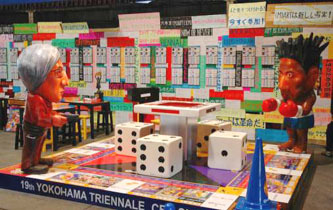
Perhaps the work that most clearly and participatorily embodied the notion of “Art Circus” were the sculptures, audience games, and painting in Navin Rawanchaikul’s (M)art project. Here the viewer was presented with an in situ studio painting, executed by two assistants, of faces drawn from the Japanese art world while based on the composition of Veronese’s The Marriage at Cana;34 the work also appeared to refer to the selection of distinguished art world celebrities in Raphael’s The School of Athens. Navin had done previous versions of this theme in Bangkok in 2004, and also in a version shown at the Basel Art Fair in 2003, in the section devoted to prospective museum purchases, a version of which had earlier been exhibited at the Palais de Tokyo in Paris. Perhaps Navin intended an even larger raspberry at the “art world” by this repletion, one which no doubt sells works and finds his assistants needed income. One of the games was even based on a fictional boxing match between Warhol and Basquiat.
Does the viewer have a fuller aesthetic experience in having the “international” art game presented in such a knowing way? If we know something of Warhol’s aesthetics of commodity fame or of Basquiat’s self-destructive expressionism, are we forced to construct a game about how they, these two art positions, would encounter one another? Do we experience the world more deeply, with more aesthetic subversion of our common conventions, for knowing we are being played with, even as we play? We could if the aesthetic experience matched the quality of the game. But I doubt that will ever be the case; and whether redemption comes through irony or tragedy or quotidian pop cynicism, I am not sure Navin thinks there is any difference at all between Beethoven and the Beatles (but I feel sure that David Oistrakh did).
Guangzhou Triennale 2005
What follows reprises a review I wrote of the Guangzhou Triennale in Asian Art News with some small revisions and by kind permission of the editor.35
The 2005 Guangzhou Triennale had for its theme, Beyond: An Extraordinary Space of Experimentation for Modernization, and the Chinese term used or invented to correspond to “beyond” is bieyang, “of a different kind or type.” Hou Hanru signed this as “alternative.”36 The exhibition was conceived as only one part of a series of activities, the most crucial of which is Delta–Lab or D-lab, which refers to the Pearl River Delta and the triangular regional linkages between Guangzhou, Zhuhai/Macao, and Hong Kong. D-lab, according to the catalogue, continued every four weeks during eighteen months of discussion and research sessions by artists and architects. The organizers’ intention was that the works in the exhibition were to be seen as the culmination or markers of a stage of continuous experimentation.
The notion of a different, separate, or “true” type of artistic creativity that is no longer concerned with the fine art object and its now-defunct processes of exhibition and canonization, and that emphasizes the process of artistic and related creation as well as the creative interpretive element contributed by the audience in constituting the artwork, comes at the end of a long line of later twentieth-century developments in art and architecture. There have also been many changes in the notion of the museum and exhibition space, which have led to a shift away from a fixed space for works categorized by their collection status and notions of period styles, and toward one where the museum is a kind of laboratory for works in progress. But these initially radical and counter-establishment notions of art objects and their exhibition interpretation were increasingly institutionalized in the late 1980s in Euramerican art school curricula and artist-run spaces, Kunsthalles, and museums of contemporary art. They found a coherent art-theoretical expression in Nicolas Bourriaud’s text for the 1993 Venice Biennale catalogue, his catalogue Traffic of 1996, and his book Relational Aesthetics (1998/2002).37 In architecture these changes derived to some extent from postmodernism and to the positioning of architectural theory as embodying the tendencies of a new urbanism found in China and Japan, exemplified perhaps most clearly in Hou Hanru and Hans-Ulrich Obrist’s 1997 catalogue for Cities on the Move, whose intellectual horizon was already that of the Dutch architect Rem Koolhaas and the theorist of globalization Saskia Sassen. In the spirit of relational participation with the art text, which found its analogue in relational participation with the “art” object or its surrogate, Hou and Obrist’s catalogue presentation displayed a transcendent act of high popularization that singularly omitted to directly cite any of the architectural theories or sociological data on which their viewpoint was based.
If relational reflection is the nexus of the artwork, why the need for historical dialectics at Guangzhou in 2005 where these tendencies had still not lost their allure? True, the architectural displays had become more coherent and allowed the visitor some purchase on their ostensible thematics. One could now interrogate them, not simply accept them as statements of faith. The artworks, still heavily dependent on viewers’ interactions with their own perceptions as the subject of the work, now found themselves in an art-museological site that consecrated the works by their singularity and by their presentation for a differentiated series of audience configurations. Viewers could drift through and choose works to match their aesthetic perceptions, even if on the ground floor one was always in danger of falling off the pre-stressed concrete wooden mold pieces over which the audience had to walk.
The return of the illusory artwork, of the transpersonal mediation of reconstituted aesthetic experiences, was in Guangzhou now locuted through a mega-exhibitory machine. The force driving this series of exhibitions was the power of economic expansion in the Pearl River Delta, and the extraordinary lust for goods without which any art materials made from the accumulation of objects, or of plastic garbage, or of building scaffolding rather elegantly transmuted into an Islamic cupbola would have been infeasible as artworks since they would lack both material and hermeneutic counterpoint.
The exhibition was held on three sites. The first of which was the Guangdong Museum of Art, with its ironic traces of earlier exhibitions and its recontextualising by new and impossibly consumable objets. The second was at a distant suburban annex in a new housing complex and paid for by its developer. The third was at a riverain leisure complex, the Xinyi International Club, nearer to the center of the city, where the works were put up for one day, and the exhibition paid for by another developer. The political and real estate company speeches at the club opening were followed by a female solo violin virtuoso dressed in a mini-skirt and boots and unafraid to jerk her pelvis while playing an electronic version of Vivaldi’s Four Seasons to a disco backing track. When there was so much cultural expression dependent on real estate selling, this supremely apposite live-musak, public onanism to the “classics” accompaniment was entirely cognate with the pale reflection of a parody of socialist kitsch, i.e., Missing Dolly by Lin Yilin, which could earlier be seen through the Guangdong Museum’s windows down the river. These post-postmodern incarnations with citations of, I guess, chakris from Mughal buildings forlornly overlooked earlier high-rise frenzies that appeared more like the embodiment of a failed utopia than simply a mere exercise in reflected bad taste. If there had been any doubt about the mendacity of high architectural theory when it was allied to brute economic desire, it was no longer possible to pass it by in the cruelly alienated lives shown by the real-estate models for the new museum annex found in the gallery space site.
The Guangzhou Triennale proffered itself as a different kind of recurrent international biennale/triennale, one with continuity between events, sites, and concepts. This was largely achieved by the holding of pre-biennale conferences, by the conceptualization of the exhibition site as an experimental laboratory (“D-Lab”), and by the recycling of conference materials and concepts though the subsequent exhibition catalogues and exhibition conceptions. What this meant in practice, however well-intentioned or grandly positioned in theory, was that it was difficult to receive any sense of engagement with artworks, and that all three catalogues produced had a great deal of informational and visual redundancy. The Guangdong specificity of the relational aesthetics of “works” and “architectural forces” disappeared under the weight of randomly ordered references that could apply to a newly developing city anywhere. Indeed what it meant to be a person from Guangdong in this field of forces rarely came to the surface. But curiously the instability of the exhibition’s informational environment closely paralleled the insecurity in the local lived environment where cross-city rush-hour bus journeys can take two hours, and muggings and petty theft are an ever-present danger (according to local residents I asked). This is before any serious consideration is given to the enormous inequalities of wealth and life opportunity unleashed by ongoing urban development. The pressure of such internal dynamics does not make it easy to validate the proposition in the exhibition essay by Hou Hanru that, “in the end, an international event happening at a specific site . . . can act as a catalyst for the local community to reinvent their own “locality” with a larger social and geopolitical framework, hence bringing more diversity to the world.”38 There would have to be more complex and much more profound and putatively “benevolent” articulation between international “catalysts” and local dynamics to allow this.
Because of the inclusion of architects among the eighty-two participants, among whom twenty-five were Chinese, it is difficult to calculate the composition ratio of non-Chinese artists to Chinese in the triennale, there in addition being twenty-three self-organized groups participating. I would guess that more than half the participants were Chinese. Among the international invitees were the “usual biennale suspects” such as Jimmie Durham, Philippe Parreno, Rikrit Tiravanija, Surasi Kusolwong, and Wong Hoy Cheong. The retread nature of some works was clear in the video shot in Guangzhou earlier in 2005 by Parreno and Tiravanija, which was co-commissioned by the Lyon Biennale where it was to be shown again later. Here both artists and their work appeared predestined to enter this closed cycle. For the moments I stayed with it, a crescent moon appeared to be setting slowly. The outstandingly banal title was Stories Are Propaganda, a topic requiring some intellectual sympathy to regard as significant, even from a standpoint in Critical Theory where “propaganda” might be allowed translation as “ideology.”
But sympathy paradoxically does have to be given to even some of the international celebrities. Isaac Julien’s interesting, split-screen composition was exhibited in small-screen, pitiful conditions, as on a bad home LCD monitor.
On the side of the international art shown, one might ask: If the effort involved in fronting this triennale produces such predictable results (as one widely exhibited Australian painter later commented, “Biennales are basically the same exhibition”), then why pretend this is other than a particular kind of group show, at least for the international selections? Why not put the architecture together with the real-estate promotions and separate it from the art exhibition? It would not significantly alter the understanding of art born out a particular urban frenzy. And it could have been far more interestingly and honestly produced as a narrow selection from a particular although now rather long-standing (ten to twelve years) and under-criticized aesthetic position, and thereby made more concrete, moving, or challenging, instead of the pretended inclusion by “generosity” and “tolerance.” The double-binds of the critical language deployed resembles Catch 22: “and you must love us.” In addition, given the presence of so many French-sourced participations at various sites, including two of the curators, several of the artists, and some visiting artist programs that coincided with the triennale, why not just call it “The New Paris School” and display its proper strengths and subject its weaknesses to a more critical gaze.
The reply might be: Well, actually the modern Asian conurbation, at least in the construction and development stage, is a site of chaos, desire, the lust for goods and wealth, the separation from the economy of need, the formation stage for concrete simulacra. Showing this by bringing the powers of the economy and cultural consecration together at once allows the viewer to see the city as a spectacle and better understand its interstitial sites. These exist in the gaps of architectural topology or the spaces in the present there for discovering, between what the structures of desire and language do not cover, and they manifest as the potential for the discovery and experience of a personal aesthetic experience. Some works in the main Guangzhou Museum site did this, particularly the highly intelligent conceptual work of Leung Chi Wo from Hong Kong. Here we actually saw with what pleasure and desire the small material signs in familiar objects were put together by the spaces constraining them. The work of Weng Fen in the category of “Self Organization”—which presumably indicated artist-run spaces and groups, such as RedSkyArt Space (Haikou)—showed the city as a spectacle of product/production given life by eggs that, lifeless but life-producing, were generated by its communication facilitation lines, and from which its buildings were formed. The work also possibly included an ironic and knowing comment on Mori Mariko’s Wave UFO shown at the Venice Biennale earlier in the year.
The “Self Organization” Vitamin Creative Space exhibited French artist Marc Boucherot’s Mobile Cinema Structure; Boucherot is the fourth visiting artist of the Back to Zhong Guo: Fools Move Mountains project with French artists. It transformed the cinema and kara-oke projection system transportable by motorized tricycle into a farming community in Nanling. In the triennale exhibition space, the projector showed digital images that had been made of the cinema performances and of their audiences. It is difficult to communicate both the delight shown on the faces of those rural audiences and the gallery audience’s pleasure at seeing this vehicle in the exhibition space, complete with neon fairy lights. Here we were brought in touch with the innocent pleasure of spectacle and the joy of participation in producing it in a simple way that was rare in other works. This was done neither out of a kind of rural nostalgia nor from aggressive socialist utopianism, but out of a sense of real-life values still held and given force by the rural population. It was as if a slice had been cut through the urban power schemes of massive buildings, or the semiotically twisted skeins of the threads of modern life, to a world where, exactly in the gaps of these structures a whole, aesthetic pleasure could be found. Maybe the success of the piece was also to be found in the rediscovery of a lost sense of quotidian decency.
But this seems far away, or a much more humble and participatory relation to daily life and lost spaces of art, from the notion of an artist as a kind of grand guerilla semionaut coursing through the architectural forces that oppress her or him. Such is the proposition of Obrist:
To resist this new totalitarian power of hyper-capitalism, claims for new kinds of freedom and agency, and social, cultural and political justice are made by the society itself. . . . Artists who search for the freedom of artistic action in cities, where there is too little space for artistic expression, invent their own spaces and channels of expression in the heart of dense urban space.39
Maybe all the artist can ever do is point or warn. Whatever their relevance or resistance, artists do not control their own circulation or that of their works, and the closed loop between elaborate international biennale conceptual frameworks, economic power or political drives, a tight group of selecting curators, and a relatively restricted group of exhibiting artists, begins to resemble the French republican art salons against which it was necessary for an avant-garde to be invented. This consecrated art with concepts of style and art practice not in the control of the salon. It allowed artistic circulation to change, as well as for groups of artists to fragment away from those institutionally recognized. A functional avant-garde today would at most be on the edges of the biennale system, but probably would exist outside it completely and might not at all be concerned with art practice, but with, for example, what voices it could make heard, what peoples it could show to themselves.
All the different biennales have different curatorial emphases due to structures based on national contents and/or conceptual schemes. There has been a general tendency to move away from the notion of a fine-art object and an artistic producer, and toward a privileging of the curatorial mediator. This figure tends not merely to be selective in classifying the past, but tries through the canonization of new work or practices to be prescriptive about how art should be made or how the art-creating process should be performed in the future.
If the second Guangzhou Biennale was intending to focus on the conditions for artistic creation in a situation of social chaos engendered by rapid economic and architectural change on a stupendous scale, then it did achieve this. But it is difficult to see such exhibitions as interventions, or “catalysts,” and they appear more part of the maelstrom itself. China may be moving away from a nineteenth-century sense of ordered development with radical shifts at positionable time-space nodes, a sense of historical order with which the first Guangzhou Biennale and its retrospective construction of Chinese modern art history may be associated. Through the representation of “self-organized” groups, Guangzhou and its contemporary artists may now be claiming a more important place within contemporary art centered in bureaucratic and artistic practice on Beijing and Shanghai. It would be an intellectually ambitious task indeed to describe what this current historical order is; but if there were small glimpses of the other avant-garde at this triennale, there was too little questioning of the triennale itself as an avatar of the forces around which it arose, even if art historians try to have the last word and freeze the contemporary just as it becomes the present. Smaller would be more beautiful, and local exhibitions could be held at the Guangzhou Museum of Fine Arts and its surrounding parks, with international components shown at a dedicated and separate, temporary site, like the massive Trade Fair buildings in Guangzhou. But then we would have to leave the future to the vacancy of spectacle itself, and perhaps the curator would not have always to be thinking of the next event, however grand, however insightful. Curators should become less visible and instead suggest indicative pathways while relinquishing a cartographing of the future which is always already the past.
1 See John Clark, Modern Asian Art, Sydney: Craftsman House, and Honolulu: University of Hawai’i Press, 1998.
2 See John Clark, “Japanese Contemporary Art and Globalization—Largely Seen from Participation in the Venice Biennale,” at Globalization, Localization, and Japanese Culture in the Asia Pacific Region, Kyoto and National University of Singapore: International Center for Japanese Studies, 2004.
3 See John Clark, “Between the Worlds: Chinese Art at Biennales Since 1993,” Yishu: Journal of Chinese Contemporary Art 4, no. 2 (2005): 40–55; John Clark, “Histories of the Asian ‘New’: Biennales and Contemporary Asian Art,” contribution to a Clark Art Institute conference on new approaches to Asian Art history, April 2006.
4 See John Clark, “Modernities in Art: How Are They ‘Other’?” World Art Studies: Exploring Concepts and Approaches, Wilfried van Damme and Kitty Zijlmans, eds., Amsterdam: Amsterdam University Press, forthcoming 2006.
5 Some memorials to equally great artistic revolutionaries also go almost unremarked, such as the absence of reference in my standard guidebook or in the building to the grave of the composer Monteverdi, found in a subchapel to the left of the main altar in the Frari church.
6 Interview of John Clark with Choi Jeong Hwa in Seoul, conducted in Japanese, September 24, 2004.
7 Including the Mizuma Art Gallery, Tokyo, in 2001; the Matrix program of the University of California, Berkeley, in 2003; and the Vancouver Art Gallery in 2003. See Bruce Grenville, curator, Home and Away, Vancouver: Vancouver Art Gallery, 2003.
8 See Rawanchaikul Toshiko, “How Were the Artists Selected?” in Rina Igarashi, ed., The 3rd Fukuoka Asian Art Triennale, 2005,Fukuoka: Fukuoka Asian Art Museum, 2005, 30–33.
9 See, inter alia, “Christie’s Going, Going to China to Hold Auctions,” New York Times, October 20, 2005.
10 In 2005, there were six curators at the Fukuoka Asian Art Museum (not including three contracted curators), nine curators at the Fukuoka Art Museum, and sixteen curators at the Fukuoka City Museum. See Kuroda Raiji, “Ajibi no 5-nen—kôryûjigyô wo chûshin ni,” in Fukuoka Asian Art Museum Collection Now: Soul of Asia, Sapporo: Hokkaidôritsu Kindaibijutsukan, 2004, 7, and personal communication.
11 Kuroda, 2004, 4, notes attendance figures as follows,
2002 | 2003* | |
| Permanent collection: | 45,472
| 56,623
|
| Special exhibitions: | 71,375
| 167,353
|
| Loan of site exhibitions: | 40,452
| 64,827
|
| Total: | 157,229
| 288,803
|
*2003 figures from a personal communication from Kuroda Raiji of October 25, 2005.
Figures in 2002 were lower because of the low attendance at the 2nd Asian Art Triennale, which occupied the whole museum, and the high attendance in 2003 at the Three Great Civilizations of Turkey exhibition. In 2002, the Asian Art Biennale only had 12,989 attendees, or 8.26% of the overall annual figure, and this even included the attendees for the exhibition of historical Asian art at the separate Fukuoka Art Museum.
12 The basic historical context and approach to setting up the Fukuoka Asian Art Museum have been analyzed in Ushiroshôji Masahiro, “‘Ajia Bijutsukan’ to iu arikata—sono imi, hôhô, shisutemu,” Ritsumeikan Gengo Bunka Kenkyû 13, no. 4 (February 28, 2002).
13 See Shireen Akbar, curator, Rickshaw Painting: Traffic Art in Bangladesh,Fukuoka: Fukuoka Asian Art Museum, Fukuoka, 1994.
14 As examples of the Japanese museums’ response to popular art and culture in the early 1990s, see Meguro-ku Bijutsukan henshû, Sengo bunka no kiseki [Japanese Culture of the Postwar Years, 1945–1995], Tokyo: Asahi Shimbun, 1995; Osamu Tezuka, et al., Tezuka Osamu ten = Osamu Tezuka, Tokyo: Tokyo Kokuritsu Kindai Bijutsukan, 1990.
15 The Pakistani selection committee member, Salima Hashmi, from Lahore, mentioned in conversation in Fukuoka, 2005, that she had raised the issue of why the Fukuoka definition of “Asia” did not extend to the Arab and other Islamic countries, and that there may have been disagreement over the kinds of cultural relations and historical ties that might be thought to have linked South, Southeast, and East Asia in pre-modern times, in however tenuous and indirect or interrupted a manner.
16 The ethnic typification of “Asian” cities merits close analysis here. According to the 2001 census out-turns, Sydney had a population of 3,961,451, of which 27.2% were born overseas; 7.8% of the entire population was born in NE Asian, SE Asian, and South Asian countries (figures for Thailand, Laos, Pakistan, and Bangladesh were not separately available, being below 10,000). If we assume a low two-children per couple, it is easy to see that the actual figure for Sydney’s Asian population is 15% or higher. In separately collected statistics, 10.03% of the population speaks one of ten major Asian languages at home. The overwhelming proportion of this fraction has Australian citizenship or permanent residence, many retaining citizenship of their original country. All these communities have clear and accepted own-cultural identities, apart from their identity as Australians. For example, the Thai community can maintain its own weekend Thai Language & Culture school and a separate six-week summer school with 100–150 attendees, and there are similar schools for each of the other communities. My own daughter’s public primary school teaches Vietnamese, Italian, Portuguese, and in some years Arabic, as background languages. See http://www.crc.nsw.gov.au/statistics/Nsw/SydneyStatisticalDivision4pp.pdf.
The Sydney figures compare with Fukuoka in 2004, where there were 16,062 registered persons of Asian nationality in Fukuoka (8,031 Chinese, 6,387 Koreans, and, among others, 104 Thais) or 1.15% of a total population of 1,391,146. See
These figures tend, surprisingly perhaps, to indicate that the population of Sydney is at least ten times more “Asian” than that of Fukuoka, which makes the most visible commitment in Japan to its being a city with “Asian” links.
17 One may mention just two of great significance: Ushiroshôji Masahiro, supervising curator, The Birth of Modern Art in Southeast Asia: Artists and Movements, Fukuoka: Fukuoka Art Museum, 1997; and Rawanchaikul Toshiko and Horikawa Lisa, eds., China Dream: Another Flow in Chinese Modern Art, Fukuoka: Fukuoka Asian Art Museum, 2004.
18 These are the Guy & Myriam Ullens Collection in France (see, Fei Dawei, ed., The Monk and the Demon, Lyon: Musée d’Art Contemporain du Lyon, 2004); the Sigg Collection in Switzerland; the Frank Uytterhagen & Pascale Geulleaume collection in Belgium (see, Hans van Dyck, ed., Modern Chinese Art Foundation, Gent: Provincie Oost-Vlanderen, 1999); and in Holland the collection of Cees Hendrikse (see http://www.beeldenaanzee.nl/).
19 They may indeed constitute a concrete provincializing of Europe. For a discussion of these issues, see Clark, Modern Asian Art, 199; Dipesh Chakravarty, Provincialising Europe: Postcolonial Thought and Historical Difference, Princeton: Princeton University Press, 2000.
20 In 2005, the Sigg Collection was exhibited from June to October at the Kunstmuseum, Bern, and thereafter at the Hamburg Kunsthalle. See the catalogue, Bernard Fibicher and Matthias Frehner, eds., Mahjong: Contemporary Chinese Art from the Sigg Collection, Ostfildern-Ruit: Hatje Cantz, 2005.
21 See the article by David Barboza, “Emperor May Be Naked, But Artist Is a Hit,” in the New York Times, May 1, 2006.
22 Szeeman wrote appreciations of Xie Nanxing, Yang Mian, and Zhou Tiehai in John Clark, ed., Chinese Art at the End of the Millennium, Hong Kong: New Art Media, 2000, and in “Harald Szeeman Talks to Chinese Artists about Venice, CCAA and Curatorial Strategies,” in Wu Hung, ed., Chinese Art at the Crossroads: Between Past and Future, Between East and West, Hong Kong: New Art Media, 2001.
23 See, The Art Newspaper, no. 156 (March 2005).
24 See, Clark, “Japanese Contemporary Art and Globalization,” op cit.
25 Makabe Kaori, Mikami Yutaka, I am grateful to many international curators, art historian colleagues, gallerists, and collectors for materials and interviews in conducting this research on biennales, and would particularly like to mention Furuichi Yasuko at the Japan Foundation, Ushiroshôji Masahiro at Kyûshû University, Kuroda Raiji and Rawanchaikul Toshiko at Fukuoka Asian Art Museum, and Ulli Sigg.
Yokohama Triennale Office, eds., Yokohama Triennale 2001, Yokohama: The Organising Committee for Yokohama Triennale, 2001, 18; from Nakamura Nobuo, “Future for Today.”
26 Yokohama Triennale 200113.
27 Yokohama Triennale 200189.
28 See, “Yokohama Toriennaare 2001 kôki—sono tenmatsu no kojinteki memorandamu,” Aica Japan Newsletter, no. 2 (November 2001).
29 Isozaki’s statement on the advertising broadsheet for the Triennale is found on the Japan Foundation’s website, www.jpf.go.jop/yt2005/e/inquiry.htm.
30 I understand that the Fukuoka Asian Art Museum was consulted on the Asian artist selections.
31 Isozaki’s views post-resignation may be found in very lively pieces from the Tama Art University symposium of December 4, 2004, organized by Tatehata Akira, whose transcriptions are in Katô Kei, et al., eds., Naze, Kokusaiten ka [Why International Exhibitions?], with Isozaki Akira, Okabe Aomi, Kitagawa Furamu, Nanjô Fumio, Hasegawa Yûko, Yokohama: BankART1929, 2005.
32 See, Yokohama Triennale 2001 , 172.
33 For an exemplification of this tendency, see Murakami Takashi, ed., Little Boy: The Arts of Japan’s Exploding Subculture, New York: Japan Society, and New Haven: Yale University Press, 2005.
34 I am grateful to Diana Gisolfi of Pratt Institute for pointing this out. I discussed the work with Navin’s assistants Chatichay Suphin and Utthit Thumthong at Yokohama in November 2005.
35 The original appeared as “A Spectacle of Questions,” Asian Art News 16, no. 1 (January/February): 68–72, with some changed emphases and illustrations. It is a remarkable testament to the dedication and tenacity of its editor Ian Findlay that this underfunded and rather straightforward art news magazine has survived in Hong Kong for fifteen years when others like it have risen, fallen, or moved to New York.
36 Alice Ming Wai Jim, “Interview with Hou Hanru” (of January 8, 2006), Yishu: Journal of Contemporary Chinese Art 5, no. 1 (March 2006): 71.
37 See Nicolas Bourriaud, Relational Aesthetics (1998), trans. Simon Pleasance and Fronza Woods, with Mathieu Copeland, Dijon: Les presses du réel, 2002; and Postproduction, trans. Jeanine Herman,New York: Lukas and Sternberg, 2002, 2nd edition, 2005.
38 Hou Hanru “Beyond: An Extraordinary Space of Experimentation for Modernization,” Second Guangzhou Triennial 2005, Guangdong: Guangdong Museum of Art, 2005, 32.
39 Hans-Ulrich Obrist, “Canton Calling: Metabolism and Beyond,” Second Guangzhou Triennial 2005, 46.
39 Hans-Ulrich Obrist, “Canton Calling: Metabolism and Beyond,” Second Guangzhou Triennial 2005, 46.