
- Chronology
- Before 1500 BCE
- 1500 BCE to 500 BCE
- 500 BCE to 500 CE
- Sixth to Tenth Century
- Eleventh to Fourteenth Century
- Fifteenth Century
- Sixteenth Century
- Seventeenth Century
- Eighteenth Century
- Nineteenth Century
- Twentieth Century
- Twenty-first Century
- Geographic Area
- Africa
- Caribbean
- Central America
- Central and North Asia
- East Asia
- North America
- Northern Europe
- Oceania/Australia
- South America
- South Asia/South East Asia
- Southern Europe and Mediterranean
- West Asia
- Subject, Genre, Media, Artistic Practice
- Aesthetics
- African American/African Diaspora
- Ancient Egyptian/Near Eastern Art
- Ancient Greek/Roman Art
- Architectural History/Urbanism/Historic Preservation
- Art Education/Pedagogy/Art Therapy
- Art of the Ancient Americas
- Artistic Practice/Creativity
- Asian American/Asian Diaspora
- Ceramics/Metals/Fiber Arts/Glass
- Colonial and Modern Latin America
- Comparative
- Conceptual Art
- Decorative Arts
- Design History
- Digital Media/New Media/Web-Based Media
- Digital Scholarship/History
- Drawings/Prints/Work on Paper/Artistc Practice
- Fiber Arts and Textiles
- Film/Video/Animation
- Folk Art/Vernacular Art
- Genders/Sexualities/Feminisms
- Graphic/Industrial/Object Design
- Indigenous Peoples
- Installation/Environmental Art
- Islamic Art
- Latinx
- Material Culture
- Multimedia/Intermedia
- Museum Practice/Museum Studies/Curatorial Studies/Arts Administration
- Native American/First Nations
- Painting
- Patronage, Art Collecting
- Performance Art/Performance Studies/Public Practice
- Photography
- Politics/Economics
- Queer/Gay Art
- Race/Ethnicity
- Religion/Cosmology/Spirituality
- Sculpture
- Sound Art
- Survey
- Theory/Historiography/Methodology
- Visual Studies
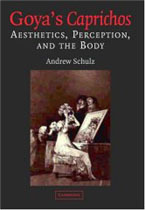
Francisco de Goya’s Los Caprichos (1799), a series of eighty etchings and aquatints, are widely known as satiric criticisms of human ignorance and folly. The artist is democratic in his critical assessment of society and its customs, from the superstitious beliefs of the lower classes to the genealogical obsession of aristocrats. Although the series includes themes particular to Spain at the turn of the century, Goya often veils these fixed references with ambiguous meanings, settings, and figures. Thus, many of the critiques expressed pictorially by Goya have application for locations and times outside of late-eighteenth-century Spain, giving the series a greater universal appeal. Moreover, the artist does not include any conciliatory finale, nor does he offer any behavioral alternatives.
Recent scholarship has focused on all aspects of this series, from Jesusa Vega’s essays on the technical analysis of Goya’s graphic works to John Ciofalo’s reading in The Self-Portraits of Francisco de Goya (Cambridge: Cambridge University Press, 2000) of the central figure in plate 43 (The Dream/Sleep of Reason Produces Monsters) as a quixotic self-portrait of the artist. Other studies, such as the exhibition “Ydioma universal”: Goya en la Biblioteca Nacional, curated by Juliet Wilson-Bareau and Elena Santiago, highlight the important relationship between Goya’s etchings and overall printmaking practices in Spain. All of these investigations have enriched the myriad contexts surrounding the artist and the production of Los Caprichos.
As a welcome addition to this body of work, Andrew Schulz’s Goya’;s Caprichos: Aesthetics, Perception, and the Body offers an insightful reading of the prints. Schulz looks to Lockian sensationalism as a means to frame his arguments regarding the somatic inversions represented in Los Caprichos. Such an epistemological structure lends a new method to understanding the satirical nature of Goya’;s etchings. In this manner, Schulz unearths lost meanings embedded in the bodily dysfunctions depicted in the series. He looks to “notions of vision and perception” as “fundamental to the poetics of Los Caprichos,” and places the prints in their aesthetic and cultural milieu (11). The senses—particularly sight—play a vital role throughout Los Caprichos. Just as Goya leaves an ambiguous trail for spectators to follow and determine possible meanings, Schulz calls for viewers to gaze more closely (using their own sense of sight) at certain commonalities in the etchings that treat two types of vision—observation and fantasy. This combination of artistic processes—the empirical study after nature and the inventive imagination of the artist—ultimately leads Schulz to place these prints between Neoclassicism and Romanticism. In addition, since several prints evidence a skewed or inadequate perception in conjunction with some type of corporeal function, the author regards Goya’s inversion of the “normal architecture of the body” to be symptomatic of the specific environment in which Goya worked (12). By situating Los Caprichos in the intersection of two distinct stylistic trends and aesthetic traditions, and between two kinds of vision, the author reassesses the relationship among Goya, Los Caprichos, and the Spanish Enlightenment.
In the introduction, aptly titled “Re-viewing Los Caprichos,” Schulz provides a chronological overview of some of the scholarly responses to and interpretations of Los Caprichos, beginning with the artist’s son, Javier, and his delivery of a short biography of his father at the prize-giving ceremony at the Royal Academy of San Fernando in 1832, and with Charles Baudelaire’s Romantic reflections several decades later. More modern efforts include those by José López-Rey, Eleanor Sayre, Nigel Glendinning, Janis Tomlinson, among many others; these figures have placed more weight on the “cultural specificity”; of late-eighteenth-century Spain to expand our knowledge of the period and of Goya’s diverse sources (4). In the context of such rich and varied material, Schulz affirms that despite Los Caprichos’s literary ties interpretations of the prints demand greater emphasis on pictorial concerns.
The first chapter treats the evolution of Goya’s depictions of bodily form from 1780 through the publication of Los Caprichos against the backdrop of the artist’s experiences at the Royal Academy in Madrid and with uncommissioned works. Schulz regards the general shift in the artist’s work from the Neoclassical principles of corporeal expressiveness to the eventual subversion of these tenets through the use of caricature and physiognomy in the 1790s as parallel to the emerging naturalistic trend, which he connects to the circulation of sensationalist ideas, particularly those of John Locke. Schulz also argues that Goya linked the principles of invention and capricho to his uncommissioned works, suggesting the direct correlation among physiognomy, caricature, and expression. For example, Schulz examines the importance of the abbreviated form of the word “caricature” written on several of the Album B (1796–97) drawings in which somatic disfigurations are featured. Moreover, Schulz looks to Madrid as a thriving artistic center with the dissemination of academic theory in prize-giving ceremonies, various commissions to honor Spanish cultural patrimony, and the publication of numerous aesthetic treatises (either of Spanish authorship or translated works). For example, in the writings of Anton Raphael Mengs, Gaspar Melchor de Jovellanos, Antonio Palomino, among others, the expression of the human form is central to academic theory and study, such as the copying of plaster casts of antique works to characterize not only the body’s exterior appearance but also its internal state. Thus, Goya’s aggressive modifications on the beautiful/heroic body seem in direct contrast to these classical ideals.
In “Modes of Spectatorship” Schulz contextualizes Los Caprichos by presenting a survey of the graphic works circulating in the Spanish print market, especially projects sponsored by the royal chalcography and the royal academy that encouraged reproductive printmaking over original designs. In such an environment, the creation of Los Caprichos seems highly unusual. Although the artist experimented with new forms of visual expression, Schulz is right to mention that Goya still maintained close ties to the academy and to court (e.g., made first painter to Charles IV in 1799). In addition, the author considers the advertisement of Goya’s etchings in the Diario de Madrid (6 February 1799), evaluating the shared aesthetic between the written description and the images; both evoke a level of uncertainty, while the document “constructs an ambiguous and problematic position for the viewer to occupy” (99). With this in mind, Schulz assesses the interaction between artist and viewer by examining the diverse array of contemporary responses to the prints. In part, Schulz attributes the confusion raised in both the etchings and the advertisement as a reason for the series’ lack of financial success. Ultimately, Los Caprichos is governed by several aesthetic dichotomies, which is why Schulz situates this series between Neoclassicism and Romanticism.
Chapter 3 deals more specifically with individual images from Los Caprichos, Album B, and the Sueños (1797–98) by tracing the artist’s portrayal of the body and the senses in direct relation to Locke’s sensationalist theories. Schulz discusses prints that reveal inverted senses as a way for the artist to ridicule contemporary practices. For example, Schulz argues that images of blindness indicate problematic mental functioning in such works as plate 29 (Esto si que es leer). Moreover, Goya’s privileging of the carnal senses suggests an inversion of the normal hierarchy of the senses, which the artist visualizes through somatic manipulations in plates like 13 (Estan calientes). Many prints also relate to contemporary debates about pedagogical reform, which were influenced by sensationalist ideas; however, in contrast to the artist’s scholarly circle, Schulz regards Goya’s lack of faith in the enlightenment creed of reason as indicative of the printmaker’s modernity. Schulz sees that in the absence of reason the “body loses its human form,” even becoming monstrous (156).
In the final chapter Schulz delves into the artistic connection between capricho and the grotesque. Although a popular form of ornamentation, the grotesque’s anti-academic characteristic is of greater concern for Schulz. Goya subverts the tenet of selective imitation; instead of assembling parts from various sources to fashion beautiful forms, he foregrounds the ugly (175). For Schulz, Goya’s application of the grotesque to produce alienating, disorienting, and irrational effects emphatically links the artist to Romanticism. Moreover, the author deploys critical strategies derived from Mikhail Bakhtin concerning more transgressive depictions of the body, and applies them to Goya’s etchings to yield a more fruitful examination. In addition, Schulz looks to the literary work of Tzvetan Todorov and Rosemary Jackson to shed light on the grotesque as a useful tool to create, in the case of Goya’s prints, visual uncertainty for the viewer. Schulz ends by evaluating Los Caprichos’s impact on nineteenth-century artists, particularly the Romantics and Symbolists.
Throughout this thoughtful and well-researched study, Schulz interweaves a series of dualities that articulates the problematic and ambiguous nature of Los Caprichos. In each chapter he considers from various perspectives the multifaceted relationship among satire, the body, and perception present in the etchings, offering fresh insight into these complex images. Goya’s Caprichos: Aesthetics, Perception, and the Body will appeal to a broad spectrum of readers, from the advanced undergraduate student to specialists in Spanish art in the eighteenth and nineteenth centuries.
Tara Zanardi
Visiting Assistant Professor, School of Architecture, Art and Historic Preservation, Roger Williams University