
- Chronology
- Before 1500 BCE
- 1500 BCE to 500 BCE
- 500 BCE to 500 CE
- Sixth to Tenth Century
- Eleventh to Fourteenth Century
- Fifteenth Century
- Sixteenth Century
- Seventeenth Century
- Eighteenth Century
- Nineteenth Century
- Twentieth Century
- Twenty-first Century
- Geographic Area
- Africa
- Caribbean
- Central America
- Central and North Asia
- East Asia
- North America
- Northern Europe
- Oceania/Australia
- South America
- South Asia/South East Asia
- Southern Europe and Mediterranean
- West Asia
- Subject, Genre, Media, Artistic Practice
- Aesthetics
- African American/African Diaspora
- Ancient Egyptian/Near Eastern Art
- Ancient Greek/Roman Art
- Architectural History/Urbanism/Historic Preservation
- Art Education/Pedagogy/Art Therapy
- Art of the Ancient Americas
- Artistic Practice/Creativity
- Asian American/Asian Diaspora
- Ceramics/Metals/Fiber Arts/Glass
- Colonial and Modern Latin America
- Comparative
- Conceptual Art
- Decorative Arts
- Design History
- Digital Media/New Media/Web-Based Media
- Digital Scholarship/History
- Drawings/Prints/Work on Paper/Artistc Practice
- Fiber Arts and Textiles
- Film/Video/Animation
- Folk Art/Vernacular Art
- Genders/Sexualities/Feminisms
- Graphic/Industrial/Object Design
- Indigenous Peoples
- Installation/Environmental Art
- Islamic Art
- Latinx
- Material Culture
- Multimedia/Intermedia
- Museum Practice/Museum Studies/Curatorial Studies/Arts Administration
- Native American/First Nations
- Painting
- Patronage, Art Collecting
- Performance Art/Performance Studies/Public Practice
- Photography
- Politics/Economics
- Queer/Gay Art
- Race/Ethnicity
- Religion/Cosmology/Spirituality
- Sculpture
- Sound Art
- Survey
- Theory/Historiography/Methodology
- Visual Studies
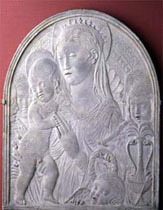
The recent exhibition, Depth of Field: The Place of Relief in the Time of Donatello, at the Henry Moore Institute in Leeds, focused on early fifteenth-century Italian relief sculptures from the collections of the Victoria & Albert Museum. Organized by Peta Motture, Glyn Davies, and Stuart Frost at the museum and by Penelope Curtis, Martina Droth, and Stephen Feeke of the Henry Moore Institute, it was the first exhibition to focus on Italian early fifteenth-century relief sculpture, and it presented the subject in a provocative and innovative way. Its specific purposes were to explore how the sculptures might be reinstalled in the new galleries under design at the Victoria & Albert and to present them in a new light—literally and figuratively—by giving them the attention they deserve. The exhibition was accompanied by a catalogue of the same title featuring three short essays on the culture of relief in late medieval Tuscany by Davies, Donatello’s relief sculptures by Motture, and the history of collecting Italian Renaissance reliefs at the South Kensington Museum (V&A) by Droth, followed by succinct entries on all the objects in the show.
The exhibition aimed to accomplish more than to focus on its masterpiece, Donatello’s marble relief of Ascension with Christ Giving the Keys to St. Peter (ca. 1428–30; cat. no. 45), hailed as the most important sculpture outside Italy by the greatest fifteenth-century sculptor. The installation in Leeds conveyed this hierarchy by isolating Donatello’s relief in the last room of the exhibition’s space. But to reach Donatello’s sculpture the visitor had to traverse two other rooms and absorb their messages, a directed traffic pattern that signaled the organizers’ attempt to accord equal importance to demonstrating the ubiquity and variety of sculpted relief in Italian urban centers during the early fifteenth century.
The first room of the exhibition established this context by displaying objects as diverse as a bishop’s crozier, a parade shield, a tomb slab, a wafering iron, and a mirror. Unique marble reliefs of religious narrative subjects, including the dramatic Lamentation by Bellano for SS. Trinità in Padua, were shown side-by-side with a variety of functional objects (for instance, chests in precious materials) purchased by wealthy Italians to celebrate social rituals such as marriage and death. The culture of gift exchange among the same economic class was represented by the portrait medals they had cast with their own likenesses and personal emblems to give to close associates, and by a colored-glass roundel of the Madonna and Child replicating the unique bronze relief that Donatello apparently created to serve the unprecedented dual function as a mold and as a gift for his doctor Giovanni Chellini. The first room also addressed issues concerning the antique and medieval origins of some forms of early fifteenth-century relief sculpture in Italy, such as the Roman coins that spurred the creation of Renaissance portrait medals, and the commonplace clay oil lamps and bowls that inspired relief techniques, and sometimes subject matter, in the later period. Medieval ivory plaques were included to represent a form of production and technique of carving that continued in fifteenth-century luxury objects like combs and chests, especially in the workshop of the Embriachi. Finally, the innovative types of carving and casting techniques inaugurated in such famous commissions as Ghiberti and Brunelleschi’s Florentine Baptistry competition panels (1400–1), Donatello’s St. George Slaying the Dragon at Orsanmichele, Florence (ca. 1417), and Donatello’s Miracles of St. Anthony from the Santo, Padua (ca. 1445–50) were evoked by nineteenth-century plaster casts that worked as surrogates for masterpieces that could not be borrowed (cat. nos. 1–5). In addition, these casts conveyed the fascination that early Italian reliefs by leading sculptors like Donatello and Ghiberti held for artists and collectors in later centuries. Their presence in the show also hinted at the practice of privileging commissioned bronze and marble religious narrative reliefs that became standard in nineteenth-century art historical discourse and led to the neglect of the replicated functional objects that were so important in the lives and devotional practices of fifteenth-century Italians.
In contrast, the second room was dedicated to relief sculptures of the Madonna and Child, the most common type of sculpture for private devotion. It displayed versions of the Virgin and Child in glazed terracotta, polychromed stucco and terracotta, and marble. Most were produced in multiples and were probably purchased readymade from workshops and then sometimes customized for the buyer. About a dozen of these relief sculptures were hung starkly against the room’s undecorated white walls, an installation that encouraged the viewer to look beyond their common subject and to reflect on their differences in technique, material, format, and figural interaction. Taken as a group, these sculptures revealed the vitality of the Byzantine icon tradition in fifteenth-century Italy. Most depicted the Virgin and Christ nestling their faces together affectionately in a rendition of the Glykophilousa composition, and they further stressed the figures’ humanity by baring Christ’s navel and genitals and by ringing his thighs with rolls of baby fat. Seeing all the Madonna and Child reliefs together created a powerful effect: one local visitor likened the experience of entering the room to a transition from the secular twenty-first century into a spiritual world.
The catalogue of the individual objects in the exhibition was edited by Curtis and organized according to their disposition in Leeds. Only by perusing these entries and absorbing their sequence can the interested reader who missed the exhibition appreciate the diverse questions that the exhibition’s organizers intended to raise by their selection of objects and display strategy. The catalogue illustrates almost all the objects in color, except for some marble reliefs, a choice most likely made because they read better in black and white. Most illustrations are small-scale, although Donatello’s Ascension with Christ Giving the Keys to St. Peter is represented in a folding-out horizontal color image that mimics its proportions. Several previously published black-and-white photographs of the sculpture are also included to demonstrate how the intensity of lighting and changes in viewing angle alter the visual impression of the very low relief-carving technique invented by Donatello called schiacciato. An unusual feature of the catalogue is the illustration of some of the objects by small color plates inserted as separate pages into the text. Their miniature size means that they function as aide-mémoires rather than as visual documents, and their lack of mounting offers no protection for the images.
The brief introductory essays broach contextual problems. Davies aims to reintegrate Donatello’s famous examples of marble and bronze relief sculpture into their material culture to suggest how fifteenth-century Italians might have responded to these objects and to make us aware of our own quite different assumptions. He emphasizes that the contemporary sculptor and theoretician Ghiberti grouped together all paintings and sculptures representing narratives, defining them by content as istorie, and not distinguishing them by technique as is the current practice. Davies sketches the medieval traditions of relief sculpture continued or adapted in the fifteenth century, countering our tendency to truncate developments by establishing separate historical periods. He reminds the reader that many sculpted objects were caressed for devotional purposes or for sheer physical delight, practices never allowed by present museums. These observations and the variety of objects in the exhibition’s first room demonstrate that the reactions of fifteenth-century Italians would have been conditioned by their visual and tactile familiarity with all sorts of relief sculpture created for practical or devotional purposes, experiences that cannot be reconstructed today. The gap between the fifteenth-century world and ours has been further reinforced by the predilection of later historians to focus on what were deemed artistic masterpieces in their time and to purposefully segregate these objects from an evaluation of their everyday context.
Motture addresses a related issue in discussing whether distinctions between the unique and the multiply replicated devotional relief mattered to fifteenth-century Italians interested in purchasing an image of the Madonna and Child. Not only were most buyers searching for an object that would stimulate piety rather than stand out for its aesthetic distinction, as she outlines, the production of a renowned sculptor like Donatello blurs any distinction between objects of very different value. The bronze Chellini Madonna (ca. 1456; cat. no. 24), one of the few securely documented sculptures by Donatello representing the Madonna and Child, was modeled on the reverse so that glass could be molded into reproductions of it, thereby collapsing any barrier between an unique object in an expensive material and cheap reproductions. She reminds us that Donatello pioneered such characteristic, influential fifteenth-century techniques as linear perspective and atmospheric perspective in relief sculpture, inspiring painters to adopt these devices. She considers how the Chellini Madonna’s placement of Mary and Christ within the illusion of an enclosing convex balustrade suggests the spatial complexity more elaborately developed in Donatello’s narrative reliefs. In some he exploited the three-dimensional possibilities of linear perspective suggested in the Chellini Madonna. In others like the Ascension with Christ Giving the Keys to St. Peter, Donatello created effects of atmosphere and spatial recession by his innovative schiacciato technique whereby he carved forms so shallowly that they seem to change and move before the viewer’s eyes.
Droth outlines the unusual circumstances in which a single figure, John Charles Robinson, amassed the Victoria & Albert’s world-famous collections of early fifteenth-century Italian relief sculpture in the second half of the nineteenth century. Bucking the period’s disregard for this type of sculpture, Robinson exploited the museum’s foundation as a repository of applied and decorative arts to justify his unpopular selections. He then had to contend with the result that museum visitors and other scholars relegated the sculptures to the category of decoration. Robinson embraced the challenge of changing these perceptions and campaigned for the recognition of their significant content and artistic quality in a series of publications about the collections. The exhibition and catalogue carry on his mission by expanding his valorizing criteria to examine how relief sculptures, including those that are exclusively decorative and the work of artisans, were perceived by fifteenth-century Italians.
The title Depth of Field seems to have been intended to connote the multiple purposes of the exhibition and its catalogue. The exhibition was a showcase of the extraordinary richness of the Victoria & Albert’s collections of Italian sculpture and featured some of its masterpieces. The selection and juxtaposition of objects allowed inspection of the ways in which levels of relief were actually created—by hand or by cast—in a variety of materials. At the same time the show and its catalogue invite us to expand our range of investigation—to include objects that once fell outside the purview of art history and to extend our study into the period’s culture through an appreciation of these objects’ roles in the everyday life of fifteenth-century Italians. The exhibition was one of the first to comprise such a broad range of objects and to explore the cultural meanings and uses of relief sculpture. This puts it in the vanguard of analyses of Italian Renaissance material culture. The exhibition’s success in paying suitable homage to the most renowned sculptures in the collection and in integrating the latest scholarly interests into their display makes enthusiasts of Italian sculpture eagerly anticipate the reinstallation of these sculptures at the Victoria & Albert.
Sarah Blake McHam
Professor, Department of Art History, Rutgers University