
- Chronology
- Before 1500 BCE
- 1500 BCE to 500 BCE
- 500 BCE to 500 CE
- Sixth to Tenth Century
- Eleventh to Fourteenth Century
- Fifteenth Century
- Sixteenth Century
- Seventeenth Century
- Eighteenth Century
- Nineteenth Century
- Twentieth Century
- Twenty-first Century
- Geographic Area
- Africa
- Caribbean
- Central America
- Central and North Asia
- East Asia
- North America
- Northern Europe
- Oceania/Australia
- South America
- South Asia/South East Asia
- Southern Europe and Mediterranean
- West Asia
- Subject, Genre, Media, Artistic Practice
- Aesthetics
- African American/African Diaspora
- Ancient Egyptian/Near Eastern Art
- Ancient Greek/Roman Art
- Architectural History/Urbanism/Historic Preservation
- Art Education/Pedagogy/Art Therapy
- Art of the Ancient Americas
- Artistic Practice/Creativity
- Asian American/Asian Diaspora
- Ceramics/Metals/Fiber Arts/Glass
- Colonial and Modern Latin America
- Comparative
- Conceptual Art
- Decorative Arts
- Design History
- Digital Media/New Media/Web-Based Media
- Digital Scholarship/History
- Drawings/Prints/Work on Paper/Artistc Practice
- Fiber Arts and Textiles
- Film/Video/Animation
- Folk Art/Vernacular Art
- Genders/Sexualities/Feminisms
- Graphic/Industrial/Object Design
- Indigenous Peoples
- Installation/Environmental Art
- Islamic Art
- Latinx
- Material Culture
- Multimedia/Intermedia
- Museum Practice/Museum Studies/Curatorial Studies/Arts Administration
- Native American/First Nations
- Painting
- Patronage, Art Collecting
- Performance Art/Performance Studies/Public Practice
- Photography
- Politics/Economics
- Queer/Gay Art
- Race/Ethnicity
- Religion/Cosmology/Spirituality
- Sculpture
- Sound Art
- Survey
- Theory/Historiography/Methodology
- Visual Studies
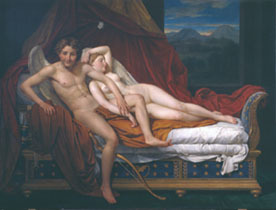
Although many of Jacques-Louis David’s best-known paintings are in French public collections, over the past century U.S. institutions such as the Cleveland Museum of Art, the National Gallery of Art, the Kimbell Art Museum, the Getty Museum, and the Clark Art Institute have managed to snap up significant works by the artist. The presence in the United States of these images, which date mainly from the Napoleonic Empire and David’s period of post-Napoleonic exile in Brussels, was the stimulus for an exhibition of David’s late work at both the Getty and the Clark last year. The exhibition was accompanied by a substantial and meticulously researched catalogue written by Philippe Bordes.
Scholars writing about David have long viewed the material featured in the exhibition as less important than the painter’s earlier production. Though highly regarded by some writers in the nineteenth- and early-twentieth centuries, the Napoleonic pictures were eclipsed in subsequent scholarly discourse by the groundbreaking history paintings of the 1780s and the images David produced during the Revolution. The Brussels pictures dropped out of view even earlier. Partly to meet the needs of teleological narratives focused on Ingres and Delacroix, the paintings were already marked in the mid-nineteenth century as symptoms of creative decline and received little attention until recently. The last major David retrospective, held in Paris in 1989, reflected and sustained this state of affairs; both the exhibition and its accompanying conference focused on the early part of David’s career. Since 1989, however, scholars have begun to see David’s post-1800 activity as rather more interesting than was previously thought. Dorothy Johnson, in particular, has played a large role in bringing David’s late works back into view by writing extensively about the artist’s continued engagement with contemporary aesthetic debates during the Empire and afterwards. Thomas Crow, Ewa Lajer-Burcharth, and Mary Vidal have also offered new frameworks for understanding David’s post-revolutionary paintings, ranging from the homosocial culture of the artist’s studio to the psychic pressures generated by the condition of exile. The Getty/Clark exhibition thus offered viewers an opportunity to take stock of these recent developments and consider new interpretive directions for the future.
At the Clark (where this reviewer saw the exhibition and participated in an accompanying symposium), the display emphasized two themes: David’s involvement with Napoleon and the artist’s always evolving engagement with classical subject matter. These themes were introduced in the first room, which juxtaposed Bonaparte Crossing the Alps at Grand-Saint-Bernard (1800–1) and Sappho, Phaon, and Cupid (1809). The early part of the exhibition then explored David’s relationship with Napoleon in greater depth through portraits of the artist and the emperor as well as with sketches David made for his large Napoleon-era compositions, such as The Coronation of Napoleon and Josephine (1805–8). The show’s second half focused on paintings and drawings that testified to David’s continued fascination with antique subjects while in exile. A final room of late portraits, many of which depict David’s fellow Napoleonic exiles, reminded us that the sense of loss thematized by much of the late work would have resonated strongly with the experience of the exiled community in Brussels.
In the exhibition catalogue, Bordes devotes his longest essay to a reassessment of David’s relationship to Napoleon. Arguing against characterizations of David as avaricious and claims that he became estranged from the emperor, Bordes suggests that David acted pragmatically during the imperial period, that he continued to receive important commissions right through to the Hundred Days, and that he remained loyal to Napoleon for the rest of his life. Even so, Bordes acknowledges that, in the final years of the Empire, David found court life limiting and withdrew into his family circle. This retreat was marked visually by an intriguing series of portraits of family members, which were included in the exhibition. These portraits represent an interesting example of David’s use of portraiture to establish links among sitters and to create communities based on common experience. In Necklines (New Haven: Yale University Press, 1999) Lajer-Burcharth discusses an earlier example of this practice: a series of portrait drawings David made of fellow Jacobins while he was in prison in the 1790s. In Brussels, David continued to work in this way, painting a series of individual portraits of Napoleonic exiles and fusing together past and present portraits in his revised copy of the Coronation (1822; not in the exhibition). The strangeness of this latter work, which includes the apparently anachronistic portrait of David’s Belgian student Joseph Odevaere alongside figures from the original painting, puts some pressure on Bordes’s characterization of David’s relationship with Napoleon and Napoleonic memory as straightforward. Another late work that David labored on for a considerable period, his Alexander, Apelles, and Campaspe (c. 1813–23), also points towards the complexity of David’s relationship with Napoleon. With Alexander and Apelles standing in for Napoleon and David, the picture shows the Greek painter caught up in multiple, unresolved transactions of power and desire with his emperor and his emperor’s mistress. Although clearly an important image for David—Jérôme-Martin Langlois shows David sketching it in an 1825 portrait of the artist—it was never finished, and, as Lajer-Burcharth suggests in Necklines, perhaps couldn’t have been.
In addition to David’s involvement with Napoleon, the show highlighted David’s renewed interest in classical themes during his exile in Brussels, where he undertook several history paintings based on subjects drawn from Greek and Roman mythology. In these paintings David experiments with narrative and compositional compression, bringing together small groups of sometimes cropped figures in tight, shallow spaces in order to heighten dramatic tension. The Getty/Clark show not only offered the rare opportunity to see these fascinating images together, it also put them in close proximity to a selection of David’s enigmatic late drawings. Neglected elements of an already neglected period in David’s career, many of these late drawings have only recently become known to art historians, having been submerged in private collections for decades. The publication in 2002 of a catalogue raisonné of David’s drawings by Louis-Antoine Prat and Pierre Rosenberg has helped give them visibility, and, judging by the interest in them at the exhibition symposium, they are likely to generate more fruitful scholarship in the near future. The drawings included in the exhibition date mainly from David’s time in Brussels and are executed in thick black crayon on heavily textured paper, producing an effect that Bordes interestingly compares to early-nineteenth-century lithographic conventions. Depicting cropped, classically dressed figures engaged in various mysterious activities, the drawings have a similar feel to the late history paintings, yet test the limits of narrative clarity to an even greater extent. Indeed, viewing the paintings and the drawings together produces the impression that in Brussels David was engaged in a dynamic, intermedial exploration of gesture and expression and their relationship to legibility. This project, which took the form of an extended, even obsessive process of combination and recombination, exceeded the bounds of a single work and seems to have acquired meaning through a notion of the series—a tendency that resonates with the artist’s portrait practice.
Given the exhibition’s interest in David’s late history paintings, its most prominent omission was David’s last work of this type: Mars Disarmed by Venus and the Graces (1824). The largest of the Brussels history paintings and the only one to be exhibited publicly in Paris during the painter’s lifetime, Mars and Venus was self-consciously conceived as a final work and as a summary statement of artistic convictions and principles. For all that, its message remains opaque. Its difficult-to-read spatial construction, its blending of idealism and realism, and its ambiguity of tone create an effect that Bordes aptly describes as uncanny. At the exhibition symposium (the papers from which will be published by the Clark), Bordes stated that when curating the show he hadn’t believed scholars to be ready for the Mars and Venus. Taking on this crucial yet underinterpreted image would now seem to be a pressing task.
Daniel Harkett
Associate Professor, Art Department, Colby College