
- Chronology
- Before 1500 BCE
- 1500 BCE to 500 BCE
- 500 BCE to 500 CE
- Sixth to Tenth Century
- Eleventh to Fourteenth Century
- Fifteenth Century
- Sixteenth Century
- Seventeenth Century
- Eighteenth Century
- Nineteenth Century
- Twentieth Century
- Twenty-first Century
- Geographic Area
- Africa
- Caribbean
- Central America
- Central and North Asia
- East Asia
- North America
- Northern Europe
- Oceania/Australia
- South America
- South Asia/South East Asia
- Southern Europe and Mediterranean
- West Asia
- Subject, Genre, Media, Artistic Practice
- Aesthetics
- African American/African Diaspora
- Ancient Egyptian/Near Eastern Art
- Ancient Greek/Roman Art
- Architectural History/Urbanism/Historic Preservation
- Art Education/Pedagogy/Art Therapy
- Art of the Ancient Americas
- Artistic Practice/Creativity
- Asian American/Asian Diaspora
- Ceramics/Metals/Fiber Arts/Glass
- Colonial and Modern Latin America
- Comparative
- Conceptual Art
- Decorative Arts
- Design History
- Digital Media/New Media/Web-Based Media
- Digital Scholarship/History
- Drawings/Prints/Work on Paper/Artistc Practice
- Fiber Arts and Textiles
- Film/Video/Animation
- Folk Art/Vernacular Art
- Genders/Sexualities/Feminisms
- Graphic/Industrial/Object Design
- Indigenous Peoples
- Installation/Environmental Art
- Islamic Art
- Latinx
- Material Culture
- Multimedia/Intermedia
- Museum Practice/Museum Studies/Curatorial Studies/Arts Administration
- Native American/First Nations
- Painting
- Patronage, Art Collecting
- Performance Art/Performance Studies/Public Practice
- Photography
- Politics/Economics
- Queer/Gay Art
- Race/Ethnicity
- Religion/Cosmology/Spirituality
- Sculpture
- Sound Art
- Survey
- Theory/Historiography/Methodology
- Visual Studies
For students of the early history of prints, these are exciting times. Recent examinations feature print publishers, particularly in the Netherlands, and catalogues of additional individual printmakers. Jan van der Stock’s remarkable Printing Images in Antwerp: The Introduction of Printmaking in a City, Fifteenth Century to 1585 (Rotterdam: Sound and Vision Interactive, 1998) engages issues of both production and consumption and expands our concept of prints far beyond fine art. Yet surviving evidence has remained scarce about the earliest collections, especially large ones, despite foundational studies by Peter Parshall, William Robinson, and Michael Bury.
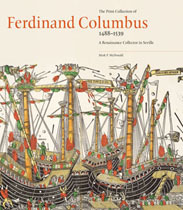
With The Print Collection of Ferdinand Columbus (1488–1539): A Renaissance Collector in Seville, the greatest early print collection has been painstakingly reconstructed under the leadership of Mark McDonald of the British Museum, supported by the Getty Grant Program. The remarkable owner of these prints, the illegitimate son of Christopher Columbus, had accompanied his father on the final voyage to the New World (1502) and later became companion and adviser in Spain to Holy Roman Emperor Charles V, as well as friend to both Desiderius Erasmus and Albrecht Dürer. At the time of his death in Seville (1539), Ferdinand Columbus owned more than 3,200 prints and more than 15,000 books, one of them a personal gift from Erasmus. While the print collection, chiefly assembled after around 1520, has been dispersed and only a few books survive, a very detailed inventory in the Columbus archive permits reconstruction of the original print ensemble.
This project has McDonald’s fingerprints all over it. Organizer of the project, he authored almost 150 pages of small-print analysis, beginning with an exemplary “life and times” of Ferdinand Columbus. His examination of the inventory ranges from codicological inspection to analysis of its classification system. McDonald has also enlisted stellar collaborators, a “dream team” of specialists from the major print rooms of Europe and America. Together, they assess the Columbus collection in terms of regional origins (Germany, Italy, the Netherlands) as well as themes (ornament, nonreligious subjects, maps and views). The scholars have firmly identified about half of the vast inventory with extant prints, including almost all of the great printmakers of the first third of the sixteenth century; additionally, those prints that have not survived are recorded here for the first time. The latest dated print in the inventory is from 1522 (153).
One of the most remarkable aspects of this collection is its organization. Like box sizes in modern print rooms, these prints too were classified first in terms of size and then by subject (sometimes described through minor details to our eyes). Comprehensiveness of subjects suggests that Columbus aspired to amass a universal collection. Moreover, within each subject, rules of hierarchy determined priority to feature saints, males, clothed figures, and humans over nonsaints, females, nudes, animals, and inanimate objects. Minute inventory descriptions of salient print features, not necessarily tied to basic iconography, facilitated discrimination among various images—especially versions of the same subject—and assisted in modern identification of specific originals in the collection. McDonald justly notes (95–96) that such scrutiny of details sustained the visuality of the period, instead of our current attention to overall space or composition. He also includes a useful overview of other early print collections and their purchase (145–55), and calculates that 70 percent of the collection came from German artists, 20 percent Italian, and 10 percent Netherlandish, with the bulk of work comprised of woodcuts. While most of these featured religious images (70 percent), the woodcuts also encompassed the full variety of subjects within current prints (but still prior to the era of landscapes).
Reconstruction of the collection forms a veritable detective story. Monograms, borders, and rosters of related, same-sized prints permit identification of extant works, and unknown or lost prints by celebrated artists can also be determined by assessing their subject and size—a process McDonald dubs “archæology.” Additionally, he considers fragments, partial replacements within prints, and variant inscriptions or dates to identify lost work. The inventory also reveals that the prints were stored in large wooden chests, some of them as series unified in a frieze on a roll (162–64). The aim of both the library and the print collection around it, McDonald deduces, was to encompass the muses and fulfill the original comprehensive ideal, like the library of ancient Alexandria.
The separate essays on Columbus’s collection take varying approaches. Fritz Koreny gives a general picture of German printmaking before 1500, praising this inventory itself as a significant milestone in the history of collecting. Prints dated to the later fifteenth century predominates the collection, which includes broadsheets and several lost woodcuts by “Caspar” of Regensburg, otherwise scarcely known. If Martin Schongauer engravings are rare, Israhel van Meckenems are plentiful; Columbus’s collection includes entire series as well as prints that remain unique survivals today. Peter Parshall examines the inventory for German prints after 1500, about 50 percent of the total contents (1,400 items), half of those identifiable. He finds works from all major centers and artists, acquired during Columbus’s three separate trips to the region. None dates after 1522. Missing prints are largely woodcuts, which seldom bore monograms. Columbus enjoyed popular subjects and larger works in this medium. The percentage of identified prints, however, remains surprisingly low for intaglios. Thus we must take period taste for woodcuts much more seriously and reckon on a high loss rate, even for a medium comprised of multiples. Dürer illustrations make up half of the identified later German prints, but there are a few chiaroscuro woodcuts and even an oversized mural composite, Christ Carrying the Cross, by Burkhord Vogtherr. Parshall makes the valid point that Columbus was not yet a collector of prints in the modern sense, but rather a collector of images based on their subjects—particularly New Testament figures or saints, as well as some informational topics, especially maps.
Italian prints, Michael Bury and David Landau determine, are early-sixteenth-century works, some 30 percent of them intaglios; however, identifiable works make up a mere 6 percent of the entire collection. The authors consider sellers of prints in Italian cities, whether artists themselves or publishers. Rolls formed one major size category of Italian prints, as in the Vendramin collection in Venice. Several are multiblock composites, including historical scenes and works by Jacopo de’ Barbari and Jacob of Strasbourg (including his own 1515 map of Venice, newly located in a vestige of Murano at the Correr). Another multiblock woodcut set, the Triumph of Christ, is ascribed to Lucantonio degli Uberti (fragments preserved in Paris); its complement is Titian’s roll with the same theme. One favorite artist, the engraver Nicoletto da Modena, is chiefly represented by a single religious series. The coauthors scrupulously interrogate both artists and publishers, for example, for the multisheet Triumph of Caesar, and underscore the fragmentary current state of preservation due to losses.
Last of the regions, the Netherlands begins with Ger Luijten’s general observations, such as the influence of these northern prints on Italians. Netherlandish images are outnumbered by German prints in Columbus’s collection but reveal his recurring preference for woodcuts. Several artists with monograms are familiar (FvB, W with the Key, IAM of Zwolle, identified with Johan van den Mynnesten), and there is a sizable, diverse group by Monogrammist S, ascribed to an Antwerp workshop. Both engravings and woodcuts by Lucas van Leyden appear, including one woodcut frieze of sibyls and another of the Biblia pauperum. Jacob Cornelisz contributed a lost Dance of Death roll, a roll of the Dukes of Holland, several images of equestrian saints, and some individual woodcut sheets. Another Leiden woodcut frieze, collected in parts, featured Soldiers and Musicians; other rolls, including a Habsburg genealogy (by Robert Peril; twenty sheets, ca. 1535), Nine Worthies (lost but copied in other media), and Prodigal Son (lost) show how much this kind of composite thematic sequencing played in Dutch woodcut production—and, again, how much has been lost. From the inventory Luijten also makes several new connections to Antwerp printmaking documentation as uncovered by van der Stock.
The remaining, wide-ranging essays tackle individual themes. Peter Fuhring, writing on ornament, provides an order often missing for such prints. Malcolm Jones, on nonreligious prints, features early themes, often comic or grotesque, with imagery of the sexes, fools, and death, as well as animals and monsters. Peter Barber’s fine survey of maps, town views, and historical prints attends to a part of visual culture often ignored by print rooms. Beginning with mappaemundi, he discovers highlights of city views like the lost Venice map, as well as the earliest recorded maps of England and France, which predate any extant versions.
This high-quality publication offers wonderful scholarly materials. A companion volume presents a translated full catalogue of the inventory, indexed according to known artists and titles of the prints. Twenty color images accompany 450 black-and-white illustrations and a CD-ROM.
For the print specialist, this entire production—led by McDonald but including his distinguished collaborators—offers a feast, whose historical significance and mine of information has been fully captured by scholarly analysis at the highest levels.
Larry Silver
Farquhar Professor of History of Art, Department of the History of Art, University of Pennsylvania