
- Chronology
- Before 1500 BCE
- 1500 BCE to 500 BCE
- 500 BCE to 500 CE
- Sixth to Tenth Century
- Eleventh to Fourteenth Century
- Fifteenth Century
- Sixteenth Century
- Seventeenth Century
- Eighteenth Century
- Nineteenth Century
- Twentieth Century
- Twenty-first Century
- Geographic Area
- Africa
- Caribbean
- Central America
- Central and North Asia
- East Asia
- North America
- Northern Europe
- Oceania/Australia
- South America
- South Asia/South East Asia
- Southern Europe and Mediterranean
- West Asia
- Subject, Genre, Media, Artistic Practice
- Aesthetics
- African American/African Diaspora
- Ancient Egyptian/Near Eastern Art
- Ancient Greek/Roman Art
- Architectural History/Urbanism/Historic Preservation
- Art Education/Pedagogy/Art Therapy
- Art of the Ancient Americas
- Artistic Practice/Creativity
- Asian American/Asian Diaspora
- Ceramics/Metals/Fiber Arts/Glass
- Colonial and Modern Latin America
- Comparative
- Conceptual Art
- Decorative Arts
- Design History
- Digital Media/New Media/Web-Based Media
- Digital Scholarship/History
- Drawings/Prints/Work on Paper/Artistc Practice
- Fiber Arts and Textiles
- Film/Video/Animation
- Folk Art/Vernacular Art
- Genders/Sexualities/Feminisms
- Graphic/Industrial/Object Design
- Indigenous Peoples
- Installation/Environmental Art
- Islamic Art
- Latinx
- Material Culture
- Multimedia/Intermedia
- Museum Practice/Museum Studies/Curatorial Studies/Arts Administration
- Native American/First Nations
- Painting
- Patronage, Art Collecting
- Performance Art/Performance Studies/Public Practice
- Photography
- Politics/Economics
- Queer/Gay Art
- Race/Ethnicity
- Religion/Cosmology/Spirituality
- Sculpture
- Sound Art
- Survey
- Theory/Historiography/Methodology
- Visual Studies
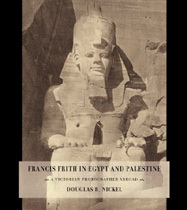
In this book Douglas Nickel explores the density of meaning and cultural significance in the photographs Francis Frith (1822–1898) took during three trips to the Middle East between 1856 and 1860. Nickel evaluates Frith’s images within the context of their production and reception: a short-lived but potent mid-Victorian configuration of aesthetics, conflicts between religious faith and scientific authority, moral improvement and photographic reproduction—all marshaled in support of Orientalist ideologies.
In the introduction Nickel sets out his argument for a history of photographic meaning that emphasizes relationships between photographic discourse and broader patterns of Western thought; Frith’s coordinate in this field is the “fitful overlap” between late Romantic Transcendentalism and Victorian rationalism (11). Within this cultural formation Frith could use the new technology of photography as an art to convince his Victorian audience of the authenticity of biblical sites and, implicitly, the historical validity of biblical narrative. Such rhetorical purposes cannot be seen in the images without a historical inquiry that looks beyond art history or technology to locate the meanings of photographs within culture. Nickel uses a “model of expanding contextualization” (19) to organize his narrative, beginning with Frith’s biography, and then to his photography, its publications, and its cultural meanings.
Chapters 1 and 2 present the data of Frith’s life, focusing on an autobiography—unfinished and unpublished—that he wrote in 1884, two decades after his travels to the Middle East. Raised in comfort in a relatively liberal Quaker household, Frith made a fortune in the grocery business in Liverpool and retired at a young age. Questioning his purpose in life, he decided to travel to Egypt in 1856, taking the daring step of bringing along the cumbersome cameras, glass negatives, and chemistry needed for wet-collodion photography to the desert. His photographs, first published in 1857, were a popular and critical success, and he became extensively involved in their dissemination. By 1861, happily established with a family but in need of funds, Frith started what became the largest photographic printing firm in England, distributing his and other photographers’ views and illustrated books of scenes in Great Britain and abroad. Frith grew more interested in religion in later life: participating in Quaker ministry, publishing theological works, and writing his autobiography. Nickel’s critical reading of the autobiography carefully evaluates Frith’s formulations of religious, philosophical, and scientific ideas in the 1880s for their relevance to his activities in the 1850s.
Chapter 3 describes Frith’s travel and photography in the Middle East. The itineraries of Frith’s first two trips (1856–57, 1857–58) conformed to established tourist routes in Egypt and Palestine. On the third and final trip (1859–60) his celebrity as a photographer prompted him to venture beyond the usual tourist preferences, revisiting previous sites and including new ones. Chapter 4 is an excellent discussion of how Frith’s images of the region were viewed and sold between 1857 and 1862. Frith’s work was popular, and his publications participated in a moment of dynamic growth in illustrated periodicals and books. The photographs were first sold as stereographs, to great acclaim, and marketed by the same publisher (Negretti and Zambra) for theatrical projection, sometimes accompanied by recited descriptions. The extent of the textual commentary varied by audience. An advertisement in the Art Journal (London) announced that its publisher, James S. Virtue, had initiated “an experiment in photography” with a publication of whole-plate photographs, each with commentary by Frith, entitled Egypt and Palestine Photographed and Described. The series was sold and distributed by subscription between 1858 and 1860; a sequel, Cairo, Sinai, Jerusalem, and the Pyramids of Egypt, with photographs from Frith’s third journey and commentary by experts in Egyptian culture, was issued in 1860 and 1861. In addition, there were exhibitions and publications of mammoth prints, the exhibition of an immense panorama of Cairo, and the production of photographically illustrated books, including two versions of the Bible, that recycled images published previously.
Chapter 5 provides an analysis of Frith’s 1859 essay, “The Art of Photography,” published by the Art Journal as Egypt and Palestine was being distributed. Nickel examines the essay’s arguments on the relative merits of photography and drawing as an implicit reference to the comparison that would be made between his book and David Roberts’s well-known lithographs of drawings of the Middle East. Nickel discusses Frith’s theory of photographic aesthetics at length. Frith valued the truthfulness of photography—which was imbued with a moral quality indebted to Ruskinian precepts—but also emphasized the medium’s impact on the viewer and the public benefits that would result. An important component of Frith’s theory concerned reception: photographs provoked an instinctive response from the viewer, heightening the reality effect of the scene depicted because it was experienced in the imagination.
In chapters 6 and 7 Nickel develops his argument that Frith’s aesthetic theory, with its focus on reception and public improvement, supported an artistic-ideological purpose for his work within contemporary disputes over the historical validity of the Bible. In chapter 6 Nickel reviews nineteenth-century debates, controversies, and accommodations of religion with science and secularism, and the specific place of Quakerism within these. This review sets the stage for characterizing Frith as a “Christian positivist” (113) who sought to put the new medium of photography to the service of conservative Christian belief and who expected his audience to be sympathetic to this combination of the secular and religious. Frith’s photographic publications invited the viewer to experience the reality of the places named in the Bible and, by extension, the historical authenticity of the events associated with these places, and then to contemplate their religious meanings.
Chapter 7 is a fascinating discussion of how Frith’s photographic theory worked in practice. Nickel describes the various pictorial and verbal devices Frith used to enhance his photograph’s effectiveness in convincing the viewer of the reality of the scene represented and supporting Frith’s religious position. Stereographs and mammoth prints presented compelling visual conditions for viewer identification, while other formats, such as the photographs in Egypt and Palestine, needed the enhancement of texts. Nickel reviews how Frith’s commentaries supplemented his images: Frith the narrator acted as surrogate viewer, enriching the photographs with associations, compensating for the unprepossessing appearance of some contemporary places, and prompting viewers to transport themselves mentally back to biblical times. Frith’s selection of historical and scriptural commentary, the theological positions of many of the patrons of Egypt and Palestine, and the reviews in the periodical press all supported the religious content and ideological purpose of the publications.
The final two chapters evaluate Frith’s Orientalism and the pertinence of biblical history to English territorial ambitions for the region. The last chapter is a powerful assessment of how Orientalism structured Frith’s projects and the expectations of his audience, an argument that retrospectively changes the significance of the material covered in the previous chapters. Nickel focuses how Frith staged the figures in his images; on his own masquerade in Eastern costume, which invited the reader to pretend to be both Western and Other; and on local subjects posed to look out of place in their own region. Nickel discusses how Frith’s images and texts transform local subjects into a single type, the Oriental, who stands outside of the historical reality imaginatively experienced by Frith’s English viewer. In the book’s brief conclusion Nickel situates Frith on the cusp between Romanticism and Realism, and proposes that Frith be considered a representative figure of his age.
Nickel presents a new, convincing characterization of Frith in this book and reframes familiar expectations of the medium and the period. He shows that mid-Victorians were not in thrall to photographic realism, but recognized and used its ideological possibilities; that the terms of Frith’s later commercial authorship cannot be retrospectively applied to the earlier publications of photographs of the Middle East because their aims were different; and that Frith made photographs in varied formats not only because he had the means to do so, but also in anticipation of how they would be viewed by an audience. Nickel’s evaluation of the religious and historical content in Frith’s projects makes historical sense of a discourse that was integral to how he worked and how Victorian audiences viewed his photographs. This discourse has been marginalized, omitted, or ignored in modern studies of the images. Nickel makes telling observations on the limitations of modernist histories of photography for work such as Frith’s: such histories assert the self-sufficiency of the image or display a willingness to edit the racism of his commentaries. In recounting Frith’s use of photography to reclaim Egypt and the Holy Land for Christendom—described in an 1858 review as an “art crusade” (19)—the book explores a cultural formation for images more suited to the high stakes involved in contemporary historical reflection on representations of the Middle East. Nickel’s sophisticated analysis of Frith’s photographic project is an important contribution to scholarship in visual culture.
Joanne Lukitsh
Associate Professor of Art History, Critical Studies Department, Massachusetts College of Art