
- Chronology
- Before 1500 BCE
- 1500 BCE to 500 BCE
- 500 BCE to 500 CE
- Sixth to Tenth Century
- Eleventh to Fourteenth Century
- Fifteenth Century
- Sixteenth Century
- Seventeenth Century
- Eighteenth Century
- Nineteenth Century
- Twentieth Century
- Twenty-first Century
- Geographic Area
- Africa
- Caribbean
- Central America
- Central and North Asia
- East Asia
- North America
- Northern Europe
- Oceania/Australia
- South America
- South Asia/South East Asia
- Southern Europe and Mediterranean
- West Asia
- Subject, Genre, Media, Artistic Practice
- Aesthetics
- African American/African Diaspora
- Ancient Egyptian/Near Eastern Art
- Ancient Greek/Roman Art
- Architectural History/Urbanism/Historic Preservation
- Art Education/Pedagogy/Art Therapy
- Art of the Ancient Americas
- Artistic Practice/Creativity
- Asian American/Asian Diaspora
- Ceramics/Metals/Fiber Arts/Glass
- Colonial and Modern Latin America
- Comparative
- Conceptual Art
- Decorative Arts
- Design History
- Digital Media/New Media/Web-Based Media
- Digital Scholarship/History
- Drawings/Prints/Work on Paper/Artistc Practice
- Fiber Arts and Textiles
- Film/Video/Animation
- Folk Art/Vernacular Art
- Genders/Sexualities/Feminisms
- Graphic/Industrial/Object Design
- Indigenous Peoples
- Installation/Environmental Art
- Islamic Art
- Latinx
- Material Culture
- Multimedia/Intermedia
- Museum Practice/Museum Studies/Curatorial Studies/Arts Administration
- Native American/First Nations
- Painting
- Patronage, Art Collecting
- Performance Art/Performance Studies/Public Practice
- Photography
- Politics/Economics
- Queer/Gay Art
- Race/Ethnicity
- Religion/Cosmology/Spirituality
- Sculpture
- Sound Art
- Survey
- Theory/Historiography/Methodology
- Visual Studies
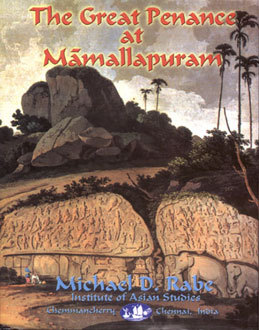
In this short essay, Michael Rabe responds to Padma Kaimal’s review of his book, The Great Penance at Mamallapuram: Deciphering a Visual Text (Chennai, Institute of Asian Studies, 2001), published in caa.reviews January 14, 2003. Rabe’s text first appeared in the spring/summer 2003 issue of the American Council for Southern Asian Art Newsletter.
With the admitted ulterior interest of an author subject to review, I would like to offer a response to a couple points made by Padma Kaimal, as my contribution to Rebecca Brown’s call for reflections on how we utilize written texts in our study of Indian art. The first goes to the very heart of my argument to the effect that the Great Penance Relief at Mamallapuram must be read as a visual text, and the second pertains more generally to scholarly method and integrity.
First, am I guilty of being “logocentric” to insist that a prasasti reading of the Relief “trumps all others meanings the sculpture may carry”? Initially, I thought not, but after perusal of several among 2,920 Google hits on the subject I now agree. Yes, it is logocentric to defend a given text against the deconstructionist’s project of undermining the very notion that intended meanings are ascertainable. Unless and until some other reading can be brought forth to trump mine, it seems like irrefutable common sense to read a narrative panel beneath palace walls of Narasiµhavarman Mahamalla as a visual prasasti, given his father Mahendravarman’s authorship of eight Sanskrit verses on framing pilasters of the Gangadhara panel at Tiruchi, verses that simultaneously praise deity and king.
Conversely, then, it follows that Kaimal takes a deconstruction stance—one inherently opposed to logocentric searches for a “presence” of intended meaning1—when inviting other scholars to make use of my accumulation of visual documentation and “potential textual correspondences” in a continued exploration of the monument. To which I say, by all means, let many further explorations flourish, but a purported decipherment cannot be dismissed out of hand without uncovering some inherent error in logic or fact that countermines it.
My initial aversion of the charge of logocentrism stemmed from the more common alternative definition of the term, one that I subsequently realized she had not intended. According to Dictionary.com, logocentric refers to a “structuralist method of analysis, especially of literary works, that focuses upon words and language to the exclusion of non-linguistic matters, such as an author’s individuality or historical context…” In other words, I misunderstood Kaimal to mean that I was short shrifting the monument’s inherent visual properties and content by an overreliance on written sources, such as the thirty-odd copper plate Pallava praßastis that survive. But actually she has nothing but high praise for my use synchronisms between several sculpture panels at Mamallapuram and texts from Sri Lanka, including even a jataka tale not previously noted in reference to a nearby panel contemporary stylistically with the Great Penance, which depicts an interlocutor monkey and peacock above elephants. Logocentricism in this sense is very much at odds with my professed desire to situate the Great Relief, jewel-in-the-lotus-like, within a mandalic frame of textual sources. Permit me to cite but the first and a more recent (unrelated) instance of several epiphanies this juxtapositioning of text with image has elicited for me, a text-crazy art historian. Vivid still as memories of the first moon walk, and nearly as long ago, I recall the camatkara astonishment the came from reading in the Mahabharata that Íiva’s pasupata weapon moved to stand bodily at Arjuna’s side: ergo, the udaremukha gana standing between them was it! Likewise, the gratification was huge, after proposing to have discovered a previously unnoted mudra in the tight triangle signed by a maithuna-king behind his lover’s back on the Laksman temple, Khajuraho—later to find it named “yoni mudrå” in the Silpaprakasa.2
The second of Kaimal’s points to which I wish to respond is the implication that I attempt to attribute the monument to a sculptor named by Dandin, despite knowledge that other scholars now assign him to a much later date. Frankly, nothing could be further from the truth. No one, to my knowledge who knows of Dandin’s still-untranslated account in the Avantisundarikathå of his visit to Mahamallapuram has doubted but that it was written by the very Pallava court poet, hailing from Kanchi, who also wrote the alamkara text called the Kåvyadarsa, and the earliest known, now lost, simultaneous Mahabharata-Ramayana conflation. Indeed, the last word known to me on this subject belongs to Yigal Bronner, in whose listing of some fifty bitextual narratives, the Great Relief I attribute to Mandhatar, and call, in part the Bhagiratha-Arjuniya, comes chronologically first, followed second by Dandin’s Dvisamdhana Kavya.3
1 Cf. Jack M. Balkin, “Tradition, Betrayal, and the Politics of Deconstruction,” part II, 1998, http://www.yale.edu/lawweb/jbalkin/articles/trad2.htm (7 Aug. 2003).
2 Michael D. Rabe, “Secret Yantras and Erotic Display for Hindu Temples,” in David Gordon White, ed., Tantra in Practice, Princeton Readings in Religion series (Princeton: Princeton University Press, 2000), 438.
3 Yigal Bronner, “Poetry at its Extreme: The Theory and Practice of Bitextual Poetry (Ílesa) in South Asia” (Ph.D. diss., University of Chicago, 1999).