
- Chronology
- Before 1500 BCE
- 1500 BCE to 500 BCE
- 500 BCE to 500 CE
- Sixth to Tenth Century
- Eleventh to Fourteenth Century
- Fifteenth Century
- Sixteenth Century
- Seventeenth Century
- Eighteenth Century
- Nineteenth Century
- Twentieth Century
- Twenty-first Century
- Geographic Area
- Africa
- Caribbean
- Central America
- Central and North Asia
- East Asia
- North America
- Northern Europe
- Oceania/Australia
- South America
- South Asia/South East Asia
- Southern Europe and Mediterranean
- West Asia
- Subject, Genre, Media, Artistic Practice
- Aesthetics
- African American/African Diaspora
- Ancient Egyptian/Near Eastern Art
- Ancient Greek/Roman Art
- Architectural History/Urbanism/Historic Preservation
- Art Education/Pedagogy/Art Therapy
- Art of the Ancient Americas
- Artistic Practice/Creativity
- Asian American/Asian Diaspora
- Ceramics/Metals/Fiber Arts/Glass
- Colonial and Modern Latin America
- Comparative
- Conceptual Art
- Decorative Arts
- Design History
- Digital Media/New Media/Web-Based Media
- Digital Scholarship/History
- Drawings/Prints/Work on Paper/Artistc Practice
- Fiber Arts and Textiles
- Film/Video/Animation
- Folk Art/Vernacular Art
- Genders/Sexualities/Feminisms
- Graphic/Industrial/Object Design
- Indigenous Peoples
- Installation/Environmental Art
- Islamic Art
- Latinx
- Material Culture
- Multimedia/Intermedia
- Museum Practice/Museum Studies/Curatorial Studies/Arts Administration
- Native American/First Nations
- Painting
- Patronage, Art Collecting
- Performance Art/Performance Studies/Public Practice
- Photography
- Politics/Economics
- Queer/Gay Art
- Race/Ethnicity
- Religion/Cosmology/Spirituality
- Sculpture
- Sound Art
- Survey
- Theory/Historiography/Methodology
- Visual Studies
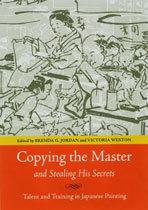
Probably everyone acquainted with Japanese art knows the two most famous anecdotes about the creation of painting. In the first, a master vexed by his student’s inability to depict a bamboo enjoins him to “become a bamboo.” No doubt apocryphal, there is nevertheless more than a grain in truth here, and this story constitutes one of the dominant myths of art production all across East Asia. This strain of thought is associated with the nanga (literati) movement, which held that there was little of value to be gleaned in the studio. Rather, aspirants should look about them and study, or, in the pithy formulation of Dong Qichang, they should “travel one thousand miles and read ten thousand books.” This credo was jokingly taken by Ike Taiga in a signature: “I’ve managed the thousand miles, but not yet read ten thousand books.”
To this anecdote, which so neatly prioritizes the experiential path of the student, assisted only by nature and antiquity, can be added another. The second tale has it that a fire once broke out in a painting master’s house and destroyed his copybooks. Without them, he could no longer function and so gave up his métier for another line of work. In that case, the studio is conceived as the prime—indeed only—locus of inspiration, such that, deprived of its lore and the store of precedents and models it contains, nothing can be achieved.
The collection of essays now under review considers the second of these two art-making casts. The scope is narrower than the title might suggest, for the chapters cover only one of the career ateliers of Japan, and only during the Edo-period manifestation (although the Meiji legacy is also considered). Pre-Edo is absent, as are core schools such as Tosa, Sumiyoshi, Sotatsu-Kōrin (a.k.a. Rinpa), the many lines in ukiyo-e, and so on. This book confines itself to the Kano and their adherents. Note that the name “Kano” is here properly given a short “o,” which will hopefully put paid to the mistaken romanization “Kanō.”
The Kano school is certainly important enough to justify a book of its own. The opening two chapters, by Karen M. Gerhart and Brenda Jordan respectively, will surely hereafter serve as one of the best introductions to the school, its corporate mechanisms, and its stylistic baggage. Until now, there has been all but nothing written on this field, which has resulted in a serious skewing of many people’s interpretation of the Edo arts. The Kano were the shogunal school, and they were everywhere—utterly dominant to a degree that the much larger body of scholarship on paintings more esteemed by modern enthusiasts and collectors would never lead one to suspect. It is most welcome to have a new volume to remind us of this.
It was Kano Yasunobu, who in 1680 provided the Kano with their motto: “One brush unchanged for ten thousand generations.” Oddly it is not quoted in this book. The “one brush” was at the disposal of the regime, which, once Kano Tan’yū was given a formal post and a stipend in the shogunal bureaucracy, meant the Tokugawa. From 1617, Tan’yū’s government mansion stood outside the Kajibashi Gate of Edo Castle, giving rise to the name of Kajibashi Kano for his line. Within a generation there were many other Kano ateliers, and by the mid-nineteenth century scores, operating not just in Edo but also in the various daimyo castle towns, in Osaka (as the Yoshimura school), and in Kyoto (as the Kyō-Kano, mistakenly romanized throughout this book as “Kyo Kano”). Their works were not for sale. Lower-grade Kano spinoff painting was available from “town-Kano” (machi-gano), masters who had not completed their training—often because as nonsamurai they lacked the status to learn the final secrets.
Yasunobu’s motto appears in a secret treatise outlining the ambitions of the Kano. His authorship is significant, for Yasunobu was not regarded as a good painter and was certainly not on a par with Tan’yū, his brother. Those who cannot do, teach, perhaps. In the treatise, Gadō yōketsu (here translated as “Secret Keys to the Way of Painting”), Yasunobu divided depiction between gakuga (learned or school painting) and shitsuga (where the unique qualities of the maker were paramount), and he placed the full weight of the Kano behind the former. Yasunobu’s text is interestingly analyzed by Gerhart, who proposes that he sought not only to validate his own mediocrity, but also specifically to take over the painting field, vacated by the demise of Tan’yū in 1764. Yasunobu was by birth superior to Tan’yū, and he now wished to assert his own uninspired mode of working as the true Kano way. Gerhart reads the treatise as a posthumous stab in the back for Tan’yū, whose inimitable genius was retrospectively judged by Yasunobu as inferior to his own hand-me-down banalities. This is an original interpretation. One could of course ask why it took Yasunobu six years to reposition himself in this way. One could also propose that, quite the opposite, he sought to secure the survival of the school, once its most towering presence was gone. Yasunobu was dying as he wrote his treatise, and he probably knew this; thus he must have recognized that his own standing would not be negotiable much longer. I would estimate that his “one brush” theory was designed to ensure that the school could function, through ups and downs, for (as he put it) “ten thousand generations,” with, inevitably, a larger number of mediocre members than outstanding ones—this was a bloodline after all. Placing the collective over the individual is a norm of the iemoto (in-house descent) system operating in many Edo skilled-artisan schools.
Knowledge of what actually went on in the Kano ateliers is scant. Two documents are well known, and here they are adduced with more extended treatment than they have hitherto received in English. The first, Kawanabe Kyōsai’s Kyōsai gadan (“Kyōsai’s Discourses on Painting”) of 1887, is discussed in Jordan’s chapter 2 and again in detail in her chapter 4, on the artist himself. As a young man Kyōsai had trained in a minor Kano atelier. The other document is also discussed by Jordan in chapter 2: it is Hashimoto Gahō’s memoir of his early life in the top Kano atelier, published two years after Kyōsai’s, in 1889. Both ex-Kano masters said more or less the same thing: that teaching was by rote, was not much fun, and that, of course, the shitsu (“unique qualities”) of the individual were not fostered. The prime source of inspiration, they agreed, was the funpon, or copybook. Naturally, by the late 1890s neither artist can be regarded as remaining agenda-free, but as both constructed their subsequent lives quite differently (Gahō reinstitutionalized himself in official Meiji art, while Kyōsai became an avowed eccentric), their agendas are not the same, and their records balance each other well.
After two chapters stressing the collective world of the Kano, who did not seek to provide the world with individual geniuses, we then move into a series of monographic chapters on notable individual painters. The institutional model, having been proposed as the governing order of the Kano school, is abruptly demolished. Three chapters follow on Kyōsai (as already mentioned), Tani Bunchō, and Okuhara Seiko. Bunchō is the earliest, but even he did not flourish until the nineteenth century. It might have been useful to know what happened to that “brush unchanged” in the century between Yasunobu and him—for change it did, and in ways that deserve elucidation. This omission is no doubt inevitable given the small number of scholars working on the Kano school. No collective volume can do more than assemble work that was already underway when the idea to publish comes into the editor’s head; perhaps someone will be inspired to research into the lacunae this book leaves. But to have nothing on the period between 1680 and almost 1890 (except Bunchō, who was peripheral to the Kano, as Frank Chance ends up showing in his otherwise worthwhile chapter) is a vitiating gap. Seiko, discussed here for the first time in English by Martha J. McClintock and Victoria Weston, was also a Meiji figure, although she had been Kano-trained in Bakumatsu. In view of Seiko’s gender, it may be pointed out, one wishes the “his” of this book’s title had been amended.
Perhaps the conclusion to be drawn is that there is little to say about bona fide Kano painters, but if so, the one-artist-per-chapter approach was perhaps not the best structure to adopt. It might have been useful to explore a more experimental means of plotting the book. At least the reform of the school under Kano Michinobu in the latter part of the eighteenth century might have been a focus, as might those artists (before and after him) who deplored what they saw as increasing sclerosis. Other arrangements can be imagined too.
I find a more significant problem in the treatment of the root contention of the book (sins of commission being greater than those of omission) in the antithesis set out between training and talent. This is an old chestnut, of course, and arguments for the one over the other are to be found wherever pedagogy is discussed. A recurrent cliché is that Western educators prefer to nurture talent, while East Asian teachers drum in facts. The Japanese Ministry of Education is grappling with this today, imagining that overemphasis on memorization has stifled innovation in Japan compared with the United States. This is all very well as a contemporary problem, but it should not be indiscriminately applied back to times past. Unfortunately the Kano school had nothing to say about “talent,” and no such notion appears in any of their writings. Our editors have misunderstood their sources, for the actual dichotomy was between Yasunobu’s gakuga and shitsuga. While it may be fair to render gaku as “training,” it will not do to gloss shitsu as “talent.” Further, shitsuga are not “[pictures produced] by natural talent” (21). When Yasunobu demeans shitsuga as less useful in providing icons in support of the state and thus as less relevant to the productivity of the Kano school, and when subsequent masters supported this view, he was not decrying talent. He would have been all in favor of it. He was decrying “unique qualities,” by which he would have understood the painting of the Chinese Southern School (later, Japanese nanga) and its attendant heterodox flourishes. Yes, the Kano were overridingly corporate, but as any CEO will tell you, “talent” is by no means anathema to good group working practices—indeed, it is essential to them. But equally no boardroom can accommodate willful eccentricity, and that was what Yasunobu could not accept.
To this major problem with the orientation of this book, I must add a smaller complaint. Despite being useful in many ways and despite putting before the reader much that is crucial for understanding Edo art, the editors have besmirched their endeavors with a catchpenny choice of title. Nothing in the Kano corpus of practice carries a notion of “stealing secrets,” and even the Kano defectors (of which Bunchō was but one) did not see themselves as engaged in larceny. The expression is explained on the first page in a quotation from an (unnamed) journalist interviewing a (twentieth-century) artist who has nothing to do with the Kano school and who does not even endorse the comment. The notion of “nusumi-geiko” is introduced later (54), and if this might be translated as “stealing secrets,” it would more accurately be rendered as something like “covert study.” The footnote here gives a generalized reference to Edo training in general, but keiko is not a term associated with Kano working patterns. “Stealing” implies a breach of trust or the flouting of a prohibition. There is little evidence that when Kyōsai slunk into his master’s storehouse to copy old works by moonlight that he felt himself to be engaged in any act of theft. Copybooks were precious, for without them the school could not exist; many were in fact valuable objects in themselves. Therefore the stores stayed off-limits to juniors. But would Kyōsai’s teacher not have reacted like a professor who found an undergraduate tricking his or her way into the university’s research collection? It is against the rules and may have to be punished, but it is also a proof of promise and not to be castigated; it may even be proof of talent. But since it is still a practice of copying, it is unlikely to result in an excess of “unique qualities.”
Weston’s final chapter on the Kano legacy puts us back on track and stands high in its level of research. She offers a fine summary of the Kano training style: it “produced some great painters, and it produced many more competent journeymen” (177), which is exactly what Yasunobu wanted to do. What could be better? Can any school hope for more?
Timon Screech
School of Oriental and African Studies, University of London