
- Chronology
- Before 1500 BCE
- 1500 BCE to 500 BCE
- 500 BCE to 500 CE
- Sixth to Tenth Century
- Eleventh to Fourteenth Century
- Fifteenth Century
- Sixteenth Century
- Seventeenth Century
- Eighteenth Century
- Nineteenth Century
- Twentieth Century
- Twenty-first Century
- Geographic Area
- Africa
- Caribbean
- Central America
- Central and North Asia
- East Asia
- North America
- Northern Europe
- Oceania/Australia
- South America
- South Asia/South East Asia
- Southern Europe and Mediterranean
- West Asia
- Subject, Genre, Media, Artistic Practice
- Aesthetics
- African American/African Diaspora
- Ancient Egyptian/Near Eastern Art
- Ancient Greek/Roman Art
- Architectural History/Urbanism/Historic Preservation
- Art Education/Pedagogy/Art Therapy
- Art of the Ancient Americas
- Artistic Practice/Creativity
- Asian American/Asian Diaspora
- Ceramics/Metals/Fiber Arts/Glass
- Colonial and Modern Latin America
- Comparative
- Conceptual Art
- Decorative Arts
- Design History
- Digital Media/New Media/Web-Based Media
- Digital Scholarship/History
- Drawings/Prints/Work on Paper/Artistc Practice
- Fiber Arts and Textiles
- Film/Video/Animation
- Folk Art/Vernacular Art
- Genders/Sexualities/Feminisms
- Graphic/Industrial/Object Design
- Indigenous Peoples
- Installation/Environmental Art
- Islamic Art
- Latinx
- Material Culture
- Multimedia/Intermedia
- Museum Practice/Museum Studies/Curatorial Studies/Arts Administration
- Native American/First Nations
- Painting
- Patronage, Art Collecting
- Performance Art/Performance Studies/Public Practice
- Photography
- Politics/Economics
- Queer/Gay Art
- Race/Ethnicity
- Religion/Cosmology/Spirituality
- Sculpture
- Sound Art
- Survey
- Theory/Historiography/Methodology
- Visual Studies
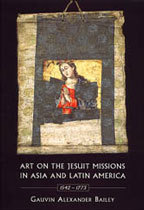
Two years after the foundation of the Society of Jesus in 1540, the first Jesuit missionary Francis Xavier disembarked at the Portuguese colony of Goa on the eastern seaboard of India. In rapid sequence, overseas missions were established on every known continent, including Japan (1549), China (1561), Mughal India (1580), and Paraguay (1609). Gauvin Bailey’s ambitious study covers the artistic production of these four outer-circle Jesuit enterprises, highlighting their affinities and regional differences over more than two centuries until the Jesuits were expelled, in 1759 from Portuguese territories and 1767 from the Spanish empire. This dense volume, based on broad visual and documentary data, fills a vacuum in the otherwise rich literature on Jesuit history. What emerges from Bailey’s art historical analysis is the astonishing power of images as worldwide carriers of the evangelistic message and, more importantly, as the lynchpin in the official Jesuit program of accommodation to indigenous cultural traditions.
Bailey contends that the key to Jesuit success lay in their tolerance and flexibility toward their potential converts or what he calls a “global partnership” between Jesuit and indigenous peoples. Artwork is used as a major index to measure this partnering. In one of the more useful sections of the book subtitled Trying to Name It" (22–31), Bailey thoughtfully reconsiders various conceptual models for colonial interaction. Discarding the traditional donor-recipient model, the author reviews a variety of alternatives, from transculturation to the more racially informed “mestizo,” before settling on a linguistic model (as does Carolyn Dean in her Inka Bodies and the Body of Christ, [Durham: NC: Duke University Press, 1999]). Using the metaphor of dialogue, Bailey characterizes hybridity in colonial arts as composed of different visual “dialects,” with varied voices being heard through visual signs. These “dialects” reference, but are independent from, international European styles such as Roman Baroque, and should clearly be judged on their own merits. The linguistic model is more apt in describing a two way, but uneven relationship between colonizer and colonized since a partnership generally suggests equality in investment and reward and does not do justice to the implicit asymmetries of power inherent in a colonial relationship regardless of the lack of coercive force, to which the Jesuits never resorted according to Bailey. Perhaps no single term can adequately encompass the multi-faceted, slippery terrain of colonial production. Bailey himself acknowledges this ambiguity by waffling on his terms: “This book is really about a partnership or a dialogue between peoples – friendly or antagonistic, overt or secretive, conscious or unconscious – and the novelty of artistic expression made possible by the fusion of their traditions…” (184).
The description of the four missions is at the core of the book, beginning with Japan and China who were considered to be the upper class among non-Europeans. Each of these chapters (3–6) is organized to review the historical context at the time of the Jesuits’ arrival and then to discuss the strategies and major players, generally divided into chronological stages. These diverse political and religious syntheses are necessary to localize the differing responses that arose in the art produced, however, in each separate case study the reader is challenged to retain a very condensed set of parameters. The political chaos of sixteenth-century Japan is contrasted with the stability of centralized rule under the Ming and Manchu Qing dynasties in China. Yet in neither case was the success of their intellectual interaction with the leadership duplicated in the religious realm because of the intractable Jesuit stance in matters of the faith, or, as Bailey puts it, of the “Jesuit dichotomy between culture and cult” (87). One of the supreme ironies in all of the missions was that their primary evangelistic efforts were aimed at the elite, yet it was at the popular level that Catholicism took hold and where devotional art was most lastingly affected.
Jesuit-sponsored workshops and academies, such as the famed Nicolo’s Seminary of Painters in Japan (active in the 1580s), trained indigenous craftsmen in Eurochristian styles and iconography, using imported painting, sculpture and most abundantly, graphics. Their production was so substantial that they were able to export their goods, and their influence impacted even mainstream art, such as Japanese screens with genre scenes of Jesuit temples. Examples of “Japanese Christian art” include the black lacquer travelling shrines (Namban) that enclose delicately painted copper or wood panels with Christian subjects executed in a traditional Japanese calligraphic style. Similarly acculturative are Chinese woodblocks, such as the Rocha illustrations, whose Christian themes are taken from Jerome Nadal’s illustrative gospel of 1593 but whose figures and drapery are “sinicized” (103), with elegantly coiled clouds borrowed from depictions of Buddhist immortals to sacralize the new biblical figures.
In the imperial courts of both China and Mughal India the tables were turned, for Jesuits artists were employed to glorify and propagandize the emperors. In one case, the talented painter, Giovanni Castiglione (1688–1766) was in the service of Chinese emperors for fifty years and his work synthesized Chinese and Western traits; in other words, the European himself was “sinicized.” Similarly, the Muslim emperors Akbar and his son Jahangir pressed Jesuits into their service, displaying bold, large-scale images of the Virgin Mary and Jesus in their throne rooms to trumpet their internationalism and legitimate their right to rule. Bailey discusses the performative role of these images in state ceremonies and, in one of his most interesting analyses, discusses the mediation of Catholic images as visual paradigms of semi-divine rule consonant with Hindu, Muslim and Mongol (Sufi) traditions. However, once again, although the arts were lavishly patronized at the highest level, conversion to Catholicism occurred primarily among commoners.
The Jesuit reductions among the warlike Guarani of Paraguay, between Spanish Peru and Portuguese Brazil, thrived precisely because there was no centralized political hierarchy and the Jesuits assumed the role of their great shamans who led entire villages on pilgrimages to a paradise-like “Land-without-Evil.” Also exceptional in Paraguay was the lack of a figural tradition among the Guarani, resulting in a different artistic amalgamation from that encountered in Asia. Bailey characterizes Catholic-Guarani artwork as blending “seamlessly” (144), combining Christian figuration with indigenous geometric patterns that conveyed the abstract essence of an object or supernatural. Indigenous characteristics are noted in the prolific sculptural corpus, drawn from some 400 stone and wood sculptures (out of an estimated 4000 in the original output). The difficulty in factoring out European and indigenous traits is most apparent here as the author is frustrated in part by the paucity of surviving examples of “pure” Guarani art and in part by the subjectivity involved in this visual exercise. Assessing indigenous qualities relies on such factors as a “sensitivity more alien to European conventions” (166), trueness to material, a schematic and rhythmic quality especially noticeable in the drapery, and a “calmness and serenity” evident particularly in the carved Christ figures that Bailey contrasts with the pathos and penitence evident in other Latin American colonial sculpture (167).
Although relying primarily on indigenous workmanship, Jesuits were industrious jacks-of-all trades. The Jesuit Giuseppe Brasanelli (1659–1728) brought to Paraguay the triumphalist style of Roman and Bavarian art of the late seventeenth century, energetically supervising altarpieces and building new stone churches (ultimately numbering over seventy-five) whose magnificence and scale is impressive even in their fragmentary remains. It is Jesuit mission architecture worldwide that most faithfully transmitted and replicated European styles.
The very strength of the volume, that is its scope and supportive detail, can detract in places. Although Bailey manages to control an immense quantity of research data and create a compelling narrative, occasionally the focus and readability of the text is lost amid a welter of names and dates which might have been consigned to appendices. I also found the illustrative portion of the book disappointing given its $65 price tag. With the exception of the book jacket, there are no color photographs and the one hundred black and whites are not placed adjacent to corresponding text nor always sequenced in the order in which they are cited. Of great value are the illustrations of unpublished artwork, although in some cases, they are inadequate to appreciate Bailey’s argument (most notably the single Guarani object, a shamanic pipe). Inexplicably, there is a total absence of the late sixteenth- and early seventeenth-century engravings, particularly by the Flemings Martin de Vos or the Wierix brothers, whose graphics were a major inspiration for both European and indigenous artists alike.
Nonetheless, this book is a major contribution and valuable resource. In Bailey’s vivid, well supported account, one comes away with a tremendous admiration for the reckless courage and intellectual drive of the international Jesuit movement and for the artistic and cultural inventiveness of the indigenous peoples with whom they collaborated. As it is becoming increasingly clear in interdisciplinary scholarship, strategies of colonization were mutually affective; the very populations whose souls were sought more often than not succeeded in using European, in this case Jesuit, ideology and visual culture to fulfill their own purposes.
Jeanette Favrot Peterson
Research Professor, Department of History of Art and Architecture, University of California, Santa Barbara