
- Chronology
- Before 1500 BCE
- 1500 BCE to 500 BCE
- 500 BCE to 500 CE
- Sixth to Tenth Century
- Eleventh to Fourteenth Century
- Fifteenth Century
- Sixteenth Century
- Seventeenth Century
- Eighteenth Century
- Nineteenth Century
- Twentieth Century
- Twenty-first Century
- Geographic Area
- Africa
- Caribbean
- Central America
- Central and North Asia
- East Asia
- North America
- Northern Europe
- Oceania/Australia
- South America
- South Asia/South East Asia
- Southern Europe and Mediterranean
- West Asia
- Subject, Genre, Media, Artistic Practice
- Aesthetics
- African American/African Diaspora
- Ancient Egyptian/Near Eastern Art
- Ancient Greek/Roman Art
- Architectural History/Urbanism/Historic Preservation
- Art Education/Pedagogy/Art Therapy
- Art of the Ancient Americas
- Artistic Practice/Creativity
- Asian American/Asian Diaspora
- Ceramics/Metals/Fiber Arts/Glass
- Colonial and Modern Latin America
- Comparative
- Conceptual Art
- Decorative Arts
- Design History
- Digital Media/New Media/Web-Based Media
- Digital Scholarship/History
- Drawings/Prints/Work on Paper/Artistc Practice
- Fiber Arts and Textiles
- Film/Video/Animation
- Folk Art/Vernacular Art
- Genders/Sexualities/Feminisms
- Graphic/Industrial/Object Design
- Indigenous Peoples
- Installation/Environmental Art
- Islamic Art
- Latinx
- Material Culture
- Multimedia/Intermedia
- Museum Practice/Museum Studies/Curatorial Studies/Arts Administration
- Native American/First Nations
- Painting
- Patronage, Art Collecting
- Performance Art/Performance Studies/Public Practice
- Photography
- Politics/Economics
- Queer/Gay Art
- Race/Ethnicity
- Religion/Cosmology/Spirituality
- Sculpture
- Sound Art
- Survey
- Theory/Historiography/Methodology
- Visual Studies
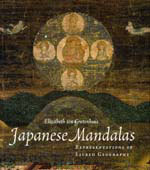
This book is a carefully constructed, well-researched study of Japanese mandala paintings. Within the broader context of pan-Asian Buddhism the most famous mandalas are those associated with Esoteric or Tantric Buddhist theology. Another important and influential type of mandala, the Taima mandala, was created to represent Buddhist doctrine of the Pure Land sect. The appearance of Japanese Esoteric and Pure Land mandalas is unquestionably derived from Chinese prototypes, but this study reveals the remarkable creativity of Japanese religious leaders and their artists as they transformed these continental models into recognizably Japanese images. This assimilation culminated with the creation of mandalas devised to represent deities and sites associated with the native Japanese Shinto religion, defined in this text as the “kami-worshiping tradition.”
In order to encompass imagery of these diverse religious ideologies under the rubric of “mandala,” ten Grotenhuis broadly defines the term as “representations of sanctified realms where identification between the human and sacred occurs” (p. 1). The author follows Japanese usage of the word “mandala,” which in eleventh-century Japan was transliterated as “mandara.” This term came to define a wide range of religious paintings associated with Buddhism and Shinto. Ten Grotenhuis defines mandara as “a kind of cosmic ground plan or map, laying out a sacred territory or realm in microcosm, showing the relations among the various powers active in that realm and offering devotees a sacred precinct where enlightenment takes place” (p. 2). In order to distinguish between orthodox Esoteric Buddhist mandalas and non-Esoteric sacred realms represented in “invented Japanese pictorial representations,” ten Grotenhuis notes the proper Japanese name of hens zu, or “transformational tableaux” for these non-Esoteric (Pure Land and kami-worshiping) mandala images, and refers to these latter types as “mandara” throughout her book. She notes that though they are visually very different, the three types of Japanese mandala/mandara that form the focus of her book share similarities of conception as they all represent places “where a believer can approach and be united with or partake of the sacred” (p. 4).
Ten Grotenhuis aims to “explain why Japanese mandalas look the way they do and how certain visual forms came to embody the sacred” (p. 1). In defense of her emphasis on visual materials, ten Grotenhuis contends that mandalas are critical to an understanding of the religious traditions with which they are associated, because study of their appearance leads “to insights not attainable through textual analysis alone” (p. 1). In her introduction and eight subsequent chronologically and thematically connected chapters, ten Grotenhuis argues this point convincingly.
The introduction familiarizes readers with religious concepts connected with mandalas, discusses their meaning for devotees, and introduces readers to their Indian and Chinese sources. One of the principal themes she introduces here is the influence of pre-Buddhist Chinese concepts, including the ordering of geographical space, on the appearance of Esoteric and Pure Land mandalas in China and the subsequent appropriation and transformation of these forms in Japanese mandara. She notes how Esoteric mandalas’ emphasis on abstract circular and square imagery becomes transformed in Japan under the influence of the kami-worshiping creed, whose mandara focus on naturalistic representations of actual Japanese scenery. Another significant theme introduced and continually reasserted throughout the book is that of the “complex syncreticism—doctrinal, ritual, visual, and literary—characteristic of the Japanese religious tradition as a whole” (p. 184).
The first chapter is a detailed inquiry into possible iconographic sources for the visual elements that comprise the Taima mandara, the oldest mandala form. Tracing its roots in India and China, the author finds strong evidence for the influences of both Indian and pre-Buddhist Chinese beliefs here. As I am not a specialist in early Chinese philosophy and religion, I cannot comment on the veracity of the author’s deductions, but I can say that the theory of identifying imagery of the Pure Land in the Taima mandara with that of Chinese notions of spatial ordering and Daoist cosmology sounds convincing as ten Grotenhuis lays it out.
Chapters Two through Five concentrate on Esoteric mandalas. In Chapter Two, the author discusses problems with identifying the iconographic sources for the Diamond World mandala, one of two mandalas (the other being the Womb World mandala) that comprise the mandala of the Two Worlds, the principal mandala of Esoteric Buddhism. Before delving into the intricacies of the mandala itself, the author provides readers with a concise introduction to Esoteric Buddhist beliefs and the cardinal function of the mandala of the Two Worlds in Esoteric religious practice. Chapter Three examines the iconography of the Womb World mandala. Here, as in the previous chapter, diagrams and line drawings of three-dimensional visualizations of these mandala provide excellent visual aids. The architectural renderings clarify the nature of painted mandala as two-dimensional representations of three-dimensional constructions. Chapter Four presents stylistic analysis of the most famous early extant paintings of Japanese mandala of the Two Worlds. The fifth chapter concludes discussion of Esoteric Buddhist mandala with introduction of mandala focusing on individual Buddhist deities that populate the Mandala of the Two Worlds. After surveying the ways Japanese scholars categorize these many paintings, ten Grotenhuis discusses their use in rituals and their uniqueness within pan-Asian Buddhism. One particularly interesting mandala introduced is the twelfth-century Star mandala, that includes symbols of the Western zodiac. This mandala becomes the focal point for an interesting digression into the history of astrology and how these symbols came to appear in Japan so far from their ancient Babylonian roots.
Chapter Six opens with a lengthy overview of the Japanese Pure Land tradition. She notes that while the creed had widespread appeal as “a popular assertion of piety against the ritualism and dogmatism of the traditional hierarchies” (p. 124), Esoteric influences persisted in its nomenclature. Then ten Grotenhuis focuses in on stylistic and iconographic analyses of specific paintings of the Taima mandara, other important types of Pure Land mandara, and Raig (welcoming descent imagery).
The book concludes with examination of paintings of mandara for the kami-worshiping tradition associated with two specific sites, Kasuga (Chapter Seven) and Kumano (Chapter Eight), whose mandara paintings are more numerous than those for other kami-worshiping cults. She avoids defining this tradition with the term “Shinto,” which implies, in its modern usage, a religion distinct from Buddhism, because there was a much closer relationship between the two religions in premodern (pre-1868) Japan. Like her other chapters, these also open with a lucid introduction to the religious tradition associated with each mandara. Similarly, the overview is followed by iconographic and stylistic analysis, invariably observant of the relationship between the image and the religious/cultural context in which it was produced. Her discussion emphasizes the syncretic nature of Japanese religion, as many of these mandara portrayed Buddhist temples and deities together with kami-worshiping imagery.
Although mandalas have been the focus of much research by Japanese scholars of religion and art history, this study is unique in its inclusive exploration of religious texts, beliefs, and sacred imagery. Characteristic of Japanese scholarship, previous studies have closely examined, mostly separately, each of these traditions: Esoteric, Pure Land, and Shinto. By defining her subject so broadly, and in ways not considered by previous scholars, the author can effectively generalize about the nature of Japanese religious tradition. At the same time, this approach allows her to reach the diverse audience she seeks: readers interested in Buddhist thought and art who are unfamiliar with the specifics of the subject as well as specialists, both art historians and scholars of Japanese religious traditions, for whom some ideas, especially those on pre-Buddhist sources for mandalas, will be new.
One of the difficulties this reader encountered repeatedly is the inadequacy of the illustrations. While there are some fine quality reproductions and many color plates, the quality of the photos is uneven and the details are often invisible. This is problematic, as much discussion centers on very detailed description of the myriad deities that populate mandala/mandara, their attributes and hand gestures, as well as landscape details found in the paintings. Though the author scrupulously provides references to other published sources for the paintings she illustrates, many are not readily available or accessible to all readers. Most references are to books and exhibition catalogues in Japanese that can be found only at specialized research libraries. I suppose that, owing to high costs for illustrated books and the need for publishers to produce volumes at a marketable price, this problem is inevitable. But in a book so indebted to visual analysis, I wish the photos could have been better. Because of the limitations of the illustrations, the book is most effective when presenting issues less dependent on visual analysis.
Complaints about the illustrations aside, ten Grotenhuis’s original and expansive study makes an important contribution to scholarship on Japanese religion and related visual imagery. She provides readers with copious references to religious and art-historical studies in both Asian and Western languages. She also offers thoughtful hypotheses about sources for this Japanese religious imagery and observations on correlations between divergent Buddhist and kami-worshiping traditions. These comments suggest new approaches to consideration of premodern forms of religious worship and their visual expressions in Japan. Consequently, I believe ten Grotenhuis’s book will become an indispensable reference to all those interested in deepening their understanding of the uniqueness of the Japanese religious tradition and its related imagery.
Patricia J. Graham
independent scholar