
- Chronology
- Before 1500 BCE
- 1500 BCE to 500 BCE
- 500 BCE to 500 CE
- Sixth to Tenth Century
- Eleventh to Fourteenth Century
- Fifteenth Century
- Sixteenth Century
- Seventeenth Century
- Eighteenth Century
- Nineteenth Century
- Twentieth Century
- Twenty-first Century
- Geographic Area
- Africa
- Caribbean
- Central America
- Central and North Asia
- East Asia
- North America
- Northern Europe
- Oceania/Australia
- South America
- South Asia/South East Asia
- Southern Europe and Mediterranean
- West Asia
- Subject, Genre, Media, Artistic Practice
- Aesthetics
- African American/African Diaspora
- Ancient Egyptian/Near Eastern Art
- Ancient Greek/Roman Art
- Architectural History/Urbanism/Historic Preservation
- Art Education/Pedagogy/Art Therapy
- Art of the Ancient Americas
- Artistic Practice/Creativity
- Asian American/Asian Diaspora
- Ceramics/Metals/Fiber Arts/Glass
- Colonial and Modern Latin America
- Comparative
- Conceptual Art
- Decorative Arts
- Design History
- Digital Media/New Media/Web-Based Media
- Digital Scholarship/History
- Drawings/Prints/Work on Paper/Artistc Practice
- Fiber Arts and Textiles
- Film/Video/Animation
- Folk Art/Vernacular Art
- Genders/Sexualities/Feminisms
- Graphic/Industrial/Object Design
- Indigenous Peoples
- Installation/Environmental Art
- Islamic Art
- Latinx
- Material Culture
- Multimedia/Intermedia
- Museum Practice/Museum Studies/Curatorial Studies/Arts Administration
- Native American/First Nations
- Painting
- Patronage, Art Collecting
- Performance Art/Performance Studies/Public Practice
- Photography
- Politics/Economics
- Queer/Gay Art
- Race/Ethnicity
- Religion/Cosmology/Spirituality
- Sculpture
- Sound Art
- Survey
- Theory/Historiography/Methodology
- Visual Studies
A number of essays and articles published in the last decade have examined the relationship between paintings produced in the Viceroyalty of New Spain (also called “colonial Mexico”) and their counterparts in peninsular Spain in early modernity. Reacting against earlier characterizations of viceregal works as uninteresting or amateurish copies of contemporaneous European prints and canvases, the more recent literature makes a claim that is by now very familiar to historians of colonial art: New Spanish painting partakes of an “Old World” tradition, but ultimately it is an autonomous phenomenon with its own history.
Creating the Cult of Saint Joseph offers a new perspective on this line of questioning. A study of seventeenth- and eighteenth-century paintings (and a few sculptures) of Saint Joseph from peninsular Spain and New Spain, it moves beyond the center-periphery model of stylistic analysis to explore other dimensions of visual imagery and cultural transformation in the early modern Hispanic world. In it, Charlene Villaseñor Black tracks the proliferation of several interrelated iconographic traditions in Europe and the Americas and, at the same time, considers visual imagery’s agency in the construction of gendered discourses on power and personhood.
Each of the book’s five central chapters explores a different facet of the author’s main argument: “The promotion of [St. Joseph’s] cult,” Villaseñor Black asserts, “was intimately linked to the imposition of a Spanish ideology of family in the colonies” (39). Visual images of the saint, the reader learns, were key agents in this imposition. Chapter 1 summarizes the history of devotion to St. Joseph in Medieval and Renaissance Europe and examines the Spaniards’ transportation of his cult to Mexico, where numerous mission churches and chapels were named for him. The author shows that New Spain was an “early locus for the flowering of Saint Joseph’s cult” (33); indeed, in 1555 he was proclaimed patron of the viceroyalty. Josephine devotion intensified in Europe and the Americas after the Council of Trent, and the year 1600—Villaseñor Black claims—marks the beginning of an increase in the production of visual images of the saint in the places under consideration.
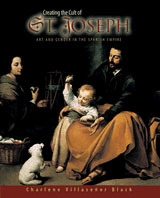
It is in this first chapter that the reader encounters Bartolomé Esteban Murillo’s Holy Family with the Little Bird (ca. 1650), the painting that appears on the book’s jacket and which is examined from a variety of angles throughout the text. That canvas, the author argues, gives “perfect pictorial form” to the paternal St. Joseph, who is offered as a model for adult male subjectivity in peninsular Spain and Mexico (36). The first chapter also offers a potentially more controversial thesis about some Josephine imagery in the Americas. Villaseñor Black suggests that in New Spain, “Joseph appears to adopt [the native Mexican deity] Tlaloc’s attributes and powers, most notably control over fertility and agriculture” (30). Scholars traditionally have acknowledged this kind of semiotic flexibility in paintings by native Mexicans in pictorial manuscripts and on monastery walls, and therefore the identification of the phenomenon in the format of canvas painting would be of considerable interest to historians of colonial art. The author’s evidence for this argument, however, comes from documents rather than from images, and the Tlaloc-Joseph conflation is presented as a possible component of the “period eye” rather than as an iconographic innovation.
Chapter 2, “Love and Marriage,” presents the first of several iconographic types or traditions that constitute the book’s central objects of inquiry. Here Villaseñor Black examines peninsular and New Spanish paintings of St. Joseph’s marriage to the Virgin Mary, suggesting that the theme’s relatively conservative iconography reinforced contemporary Catholic discourses on matrimony and facilitated the transfer of the practice to Mexico, where indigenous families and communities had been structured differently. “By upholding Church-sanctioned monogamy as the only alternative,” she writes, “these images helped extend Church control over indigenous converts’ lives. Christian marriage thus became a form of colonialism” (56). At the end of the chapter, however, Villaseñor Black comments on the failure of the enterprise she describes. Modifying Marina Warner’s argument about the Virgin Mary in Alone of All Her Sex (New York: Knopf, 1976), she proposes that “the figure of Joseph remained for most men an unattainable, nearly superhuman ideal” (57). This is a recurring motif throughout the book. The author repeatedly notes that the practices and behaviors promoted by the Josephine imagery are at odds with other kinds of historical evidence that reveal a less ideal vision of male subjectivity in peninsular Spain and colonial Mexico.
In chapter 3, “Happy Families,” the author turns from marriage imagery to Spanish and New Spanish paintings of the Holy Family. She shows that the iconography for this theme underwent a radical change in the 1610s and 1620s in which “Joseph emerged from the shadows and began to share the compositional foreground with his holy wife and foster Son” (63). Pointing again to Murillo’s Holy Family with the Little Bird as an example of this iconographic tendency, Villaseñor Black considers the visual evidence in the context of early modern texts that similarly present the figure of St. Joseph as the paradigmatic paterfamilias. The author notes, however, that many images of the Holy Family produced in seventeenth- and eighteenth-century Mexico continued to give prominence to Mary and, in some cases, to her mother, St. Anne. This is one of the moments in the book in which Villaseñor Black argues most forcefully for the autonomy of New Spanish art, suggesting that this iconographic distinction between the art of peninsular Spain and that of the viceroyalty may relate to the persistence in the latter of indigenous family structures “which were more matriarchal in nature and frequently composed of extended kin networks” (84).
The image of St. Joseph as the ideal paterfamilias is further explored in chapter 4. Here, the author centers on paintings (and one sculpture) that represent the saint and his son, and which focus on the intimacy of the relationship between the two. The images, which include representations of Joseph holding the child in his arms, standing next to him, or guiding him as they walk together, are presented as evidence of “a new discourse of ideal masculinity” (90) and “a model [for fathers] to emulate in guiding their children” (96). The chapter’s title, “Mothering Fathers,” underscores Villaseñor Black’s observation that images of Joseph and the Christ child often “adapted existing Marian pictorial strategies to emphasize the physical contact between Joseph and Jesus” (100).
The book’s final two chapters draw away slightly from the paterfamilias theme to consider other kinds of Josephine iconography and their resonance with the principles and logic of Spanish imperial administration. Chapter 5, “Men at Work,” studies visual representations of St. Joseph in his workshop. The author argues that such images “became powerful symbols of the honor of manual labor” (117) as well as “icons of hope” and “tools of social control” (131) in a society where poverty was seen as a threat to the state’s stability and authority. In chapter 6, “The Good Death,” Villaseñor Black examines two distinct iconographic traditions representing events from the end of St. Joseph’s life: his Death and his Coronation. She establishes an affinity between the first of these themes and contemporary discourse on “the good death,” a concept she says may have resonated in particular ways with Mexican culture and “its acceptance of death as part of life” (146). The second theme, the author notes, is one rarely represented in peninsular painting but which is more frequent in colonial Mexican art. She attributes this intriguing divergence to the rhetoric of colonial administration, in which St. Joseph was cast as “God’s viceroy” and, simultaneously, as a representation of the monarchy in New Spain.
Art and Gender in the Spanish Empire, the subtitle to Creating the Cult of Saint Joseph, suggests a more expansive field of inquiry than the one undertaken in this book, and it would indeed be interesting to know what kinds of Josephine iconography flourished in other parts of the Spanish monarchy in the seventeenth and eighteenth centuries. This volume would be vital to such an investigation. But in addition to its utility as a source on the history of images of St. Joseph in peninsular Spain and New Spain, Villaseñor Black’s book is of broader value in that it provides a fresh view of the political economy of religious art in colonial Mexico. As such, it complements recent scholarship on the complex symbolism of the Virgin of Guadalupe and the Archangel St. Michael in New Spain, and provides an attractive model for future research in this field.
Michael J. Schreffler
University of Notre Dame