
- Chronology
- Before 1500 BCE
- 1500 BCE to 500 BCE
- 500 BCE to 500 CE
- Sixth to Tenth Century
- Eleventh to Fourteenth Century
- Fifteenth Century
- Sixteenth Century
- Seventeenth Century
- Eighteenth Century
- Nineteenth Century
- Twentieth Century
- Twenty-first Century
- Geographic Area
- Africa
- Caribbean
- Central America
- Central and North Asia
- East Asia
- North America
- Northern Europe
- Oceania/Australia
- South America
- South Asia/South East Asia
- Southern Europe and Mediterranean
- West Asia
- Subject, Genre, Media, Artistic Practice
- Aesthetics
- African American/African Diaspora
- Ancient Egyptian/Near Eastern Art
- Ancient Greek/Roman Art
- Architectural History/Urbanism/Historic Preservation
- Art Education/Pedagogy/Art Therapy
- Art of the Ancient Americas
- Artistic Practice/Creativity
- Asian American/Asian Diaspora
- Ceramics/Metals/Fiber Arts/Glass
- Colonial and Modern Latin America
- Comparative
- Conceptual Art
- Decorative Arts
- Design History
- Digital Media/New Media/Web-Based Media
- Digital Scholarship/History
- Drawings/Prints/Work on Paper/Artistc Practice
- Fiber Arts and Textiles
- Film/Video/Animation
- Folk Art/Vernacular Art
- Genders/Sexualities/Feminisms
- Graphic/Industrial/Object Design
- Indigenous Peoples
- Installation/Environmental Art
- Islamic Art
- Latinx
- Material Culture
- Multimedia/Intermedia
- Museum Practice/Museum Studies/Curatorial Studies/Arts Administration
- Native American/First Nations
- Painting
- Patronage, Art Collecting
- Performance Art/Performance Studies/Public Practice
- Photography
- Politics/Economics
- Queer/Gay Art
- Race/Ethnicity
- Religion/Cosmology/Spirituality
- Sculpture
- Sound Art
- Survey
- Theory/Historiography/Methodology
- Visual Studies
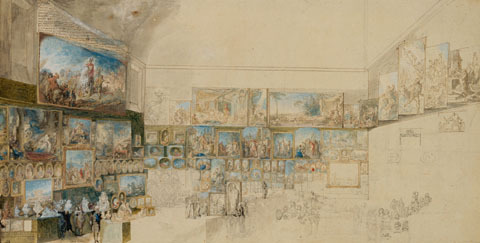
Although not well known to the general public, the eighteenth-century French painter and draughtsman Gabriel de Saint-Aubin has long compelled specialists working on virtually every aspect of Parisian social and cultural life. His exuberant depictions took the form of drawings in chalk, ink, and watercolor, as well as etchings and a few oil paintings, while his subjects ranged over most aspects of the cultured world around him: social interaction both high and low; theater; royal ceremony; legal proceedings; portraiture; history; architecture and ornamental design; and the unique product for which he is best known, miniature depictions of other artists’ works sketched into the margins of auction catalogues, books of poetry and prose, and especially the livrets published to accompany the biannual exhibitions of the Royal Academy of Painting and Sculpture. Saint-Aubin, in addition, created several ambitious depictions of the exhibitions themselves, works that offer not only a view into how art met its public in eighteenth-century France, but also, more specifically, what works were displayed when, and how they were physically organized and mounted on the walls of the Salon Carré in the Louvre. Despite their enormous importance to scholars, and their witty, humanist appeal, Saint-Aubin’s works have rarely been exhibited in recent times, either in North American or in Europe. The retrospective exhibition at the Frick Collection, on view from October 30, 2007 to January 27, 2008, offered a rich opportunity for today’s public to study Saint-Aubin’s unique vision of public life in his own era.
A week before the exhibition closed, the Frick Collection staged a “study day” at which scholars from the museum world and academia presented papers that highlighted the diversity and complexity of Saint-Aubin’s output. It is a testament both to the artistry of Saint-Aubin and to the astuteness of the study day organizers that every one of the twelve papers contributed substantially to the interest of the day-long event; graduate students in search of thesis topics could have found a wealth of possibilities in these informed and provocative presentations about an artist who has heretofore received much less attention than he is due. The day was well structured to guide the audience through Saint-Aubin’s practice and then immerse us in the questions and problems his work generates. The morning session featured six presentations by museum and art-market specialists on Saint-Aubin’s artistic production, while in the afternoon session six more scholars—including curators and professors of art history, history, and French—queried his images from social, political, economic, and psychological angles. All four of the exhibition’s organizers contributed papers. The presenters, like the audience, appeared to enjoy immensely the multiple, overlapping themes that emerged, and everyone benefited from having the exhibition immediately at hand for repeated viewing throughout the day.
Suzanne Folds McCullagh, curator of prints and drawings at the Art Institute of Chicago, began the morning session with an overview of Saint-Aubin’s drawings and some of the key problems that they raise. Drawings comprise by far the largest category of Saint-Aubin’s output, and McCullagh brought out the enormousness of the challenge confronting any connoisseur who tries to pinpoint the context in which they were made, and how they interrelate one with another. Like Antoine Watteau, a predecessor who looms large in Saint-Aubin’s social subjects and figural artistry, Saint-Aubin made many of his drawings in sketchbooks whose pages teem with figures, objects, landscapes, architectural fragments, and miniature scenes of dramatic action.
Only a few of these sketchbooks survive intact, in the collections of the Art Institute of Chicago, the Fogg Art Museum, and the Louvre. Although none appeared in the exhibition at the Frick Collection, Christophe Leribault, one of the exhibition’s French organizers and the chief curator of graphic arts at the Louvre, focused his presentation upon the Groult Album, which will be included in the exhibition’s second and final showing at the Louvre this spring. Named after the collector from whom the Louvre bought the sketchbook in 1941, the Groult Album features the full range of Saint-Aubin’s numerous subjects from 1759 to 1765–8, as well as some drawings that were pasted in at a later time. Among the latter is what appears to be Saint-Aubin’s lively, preliminary idea for the well-known drawing of “Voltaire’s Coronation” of 1778 in the Louvre. Original pages in the sketchbook feature fascinating juxtapositions of seemingly disparate elements, as well as arch combinations of the real and the fanciful, such as a view of the east façade of the Louvre in a fragmentary state. Saint-Aubin, in a documentary spirit, dated a good many of his scenic drawings, often including the month and the day, and even, at least in one case, the time of day—“sept heures du soir.” A facsimile publication of the Groult album is currently in the works.
Pierre Rosenberg, President-Director Emeritus of the Louvre and the other French organizer of exhibition, continued the close examination of Saint-Aubin as a graphic artist by focusing upon the drawing collection of the eighteenth-century connoisseur and publisher Pierre-Jean Mariette. Here we received an excellent example of the informative nature of Saint-Aubin’s illustrations in sale catalogues: Rosenberg and the Association Mariette pour la promotion du dessin français are using them to specify the exact contents of Mariette’s huge and wide-ranging collection, in preparation for a catalogue raisonné. Oddly, Mariette never mentioned Saint-Aubin in his own writings, but Saint-Aubin’s multifarious sketches in the margins of the sale catalogue of Mariette’s collection (now in the Museum of Fine Arts, Boston) show how well Saint-Aubin came to know Mariette as a collector. In the next paper of the session Alan Wintermute, Director of Private Sales at Christie’s, turned our focus to the paintings of Saint-Aubin—much fewer in number than the drawings, and thus less well-known. Saint-Aubin’s paintings reveal not just the heritage of Watteau, but also close connections with his contemporary Fragonard and, more surprisingly, with the earthy intimacy of Chardin.
In a fascinating paper Perrin Stein, curator of drawings and prints at the Metropolitan Museum, examined Saint-Aubin as a printmaker, expanding on her entries in the exhibition catalogue. Taking us through the states of particular etchings, Stein brought her audience inside Saint-Aubin’s process, and also exposed the difficulties he had with certain elements of design, especially composition and perspective. We watched the way in which Saint-Aubin altered an etching of the Salon exhibition of 1753 to produce a view of the Salon of 1767, including a tiny but telling adjustment he made to update the fashion in a male sleeve. In observing Saint-Aubin’s struggles to plot coherent large views Stein considered drawings as well, such as Saint-Aubin’s unfinished portrayal of the Salon of 1765. Although filled with detail in the rendering of the works of art, the drawing lacks the balustrade of the Stairway of the Infanta, which should have appeared on the left, and also displays some inconsistencies in perspective on the two side walls. Stein suggested that Saint-Aubin’s difficulties with perspective and large-scale composition may have stemmed in part from his very expertise in creating exceptionally small-scale tableaux.
In the final paper of the morning Colin Bailey, chief curator at the Frick Collection and one of the exhibition’s United States organizers, continued the close inspection of Saint-Aubin’s graphic work by focusing upon the abundant drawings, legendarily numbering “100,000 and counting.” Bailey exposed the challenges one faces in tracking Saint-Aubin’s exuberant illustrations of sale catalogues and other publications: although they all look at first glance to have been executed on the spot, some were made from memory after the fact, confirming the claim made by Saint-Aubin’s contemporaries that he could reproduce a painting after seeing it only briefly—what we today might call photographic recall.
Complexity was the watchword of the afternoon session, whose speakers addressed Saint-Aubin’s views into eighteenth-century Parisian life. So provocative and varied were these papers that one wondered how Saint-Aubin could have evaded scholarly analysis for so long after the groundbreaking publications of Émile Dacier in the second quarter of the twentieth century. Guest curator Kim de Beaumont, who with Bailey organized the United States exhibition, has devoted most of her scholarly career to studying Saint-Aubin, an intricate challenge whose rewards she made vivid in recounting her research process. Other speakers took up particular aspects of Saint-Aubin’s subjects, beginning with his interest in the material world: Katie Scott, Professor of the History of Art at the Courtauld Institute, examined Saint-Aubin’s portrayals of buying and selling in light of his culture’s growing commercialism, and Caroline Weber, Associate Professor of French at Barnard, considered his attention to clothes within the larger context of Parisian fashion. What emerged from both papers was an eighteenth-century material culture on the rise and constantly in flux, and an artist who matched this unstable expansion in his prolific attention to people and their goods. Scott noted Saint-Aubin’s tendency to objectify humans and to animate things, thereby setting the two in constant play. Weber offered a historical picture of the search for novelty that drove Saint-Aubin’s urban fashionistas, leading one to wonder whether fashion itself could have impelled Saint-Aubin’s restless figural artistry.
Subsequent speakers argued that Saint-Aubin also cast a sharp eye on the social and political tensions that edged into the Parisian scene in the decades preceding the Revolution. Juliet Carey, curator at Waddesdon Manor, speculated as to Saint-Aubin’s involvement in the Livre de caricatures tant bonnes que mauvaises (ca. 1740–ca. 1775), a volume of satirical prints and drawings compiled and principally authored by his older brother, Charles-Germain de Saint-Aubin. She noted correlations between Saint-Aubin’s characters and the victims of the trenchant satires in the Livre de caricatures, as well as their mutual interest in Folly, a personification who presided over much eighteenth-century expression, including the “subversive wit” of the brothers Saint-Aubin. (Scholars will soon be able to explore the Livre de caricatures in print and online through a catalogue forthcoming from Waddesdon Manor.) The historian John Shovlin, of New York University, explored Saint-Aubin’s representations of key royal events and monuments, as well as scenes featuring the Parisian Parliament and the legal profession in general. Zeroing in on Saint-Aubin’s eloquent minutiae, Shovlin argued that although Saint-Aubin overtly celebrated Louis XV as the “bien aimé,” and Louis XVI as his able successor, he also alluded to the struggles between King and Parliament in small, even covert, details. In one of the symposium’s most nuanced papers, Harvard University’s Ewa Lajer-Burcharth also called attention to Saint-Aubin’s details, but in this case to consider the social and psychological implications of his repeated pictorial strategies. Lajer-Burcharth noted the “pockets of intimacy” to be found in Saint-Aubin’s representations of urban life, as seen in figures gathered closely within public spots, or catching a view of a larger, peopled space from a sheltered or hidden angle. Voyeurs, often pictured from the back, recur in Saint-Aubin’s imagery, as they also sometimes appear in works by his contemporaries such as Fragonard. Lajer-Burcharth connected this visible consciousness of the act of viewing to a new genre of literature that aimed to enter and explore the Parisian scene, as played out, for example, in the writings of Saint-Aubin’s contemporary, Restif de la Bretonne. Drawing upon psychoanalytic theory, Lajer-Burcharth proposed that Saint-Aubin both coveted and distanced the objects of his view, and she interpreted as a form of obsessive excess his repetitions, reworkings and efforts to fill every corner with something to see.
Gabriel de Saint-Aubin emerged from his Frick “study day” as an artist whose works warrant virtually every kind of art-historical study, from connoisseurship and the history of collecting to a range of theoretical approaches. As Kim de Beaumont made clear in describing her own journey through Saint-Aubin’s many thousands of works, the questions they raise as to subject, process, historical implications, and psychological effect impinge upon one another in a complex and, for many, irresistible web.
Sarah R. Cohen
Departments of Art and Art History and Women’s, Gender and Sexuality Studies, University at Albany, State University of New York